FAB-627415890
M1566 50% Ramie 50% Lyocell Blend Fabric 260 GSM 145cm Width – for Trousers, Suits and Jackets
Quote required
Contact us for the latest price and availability.
- Composition
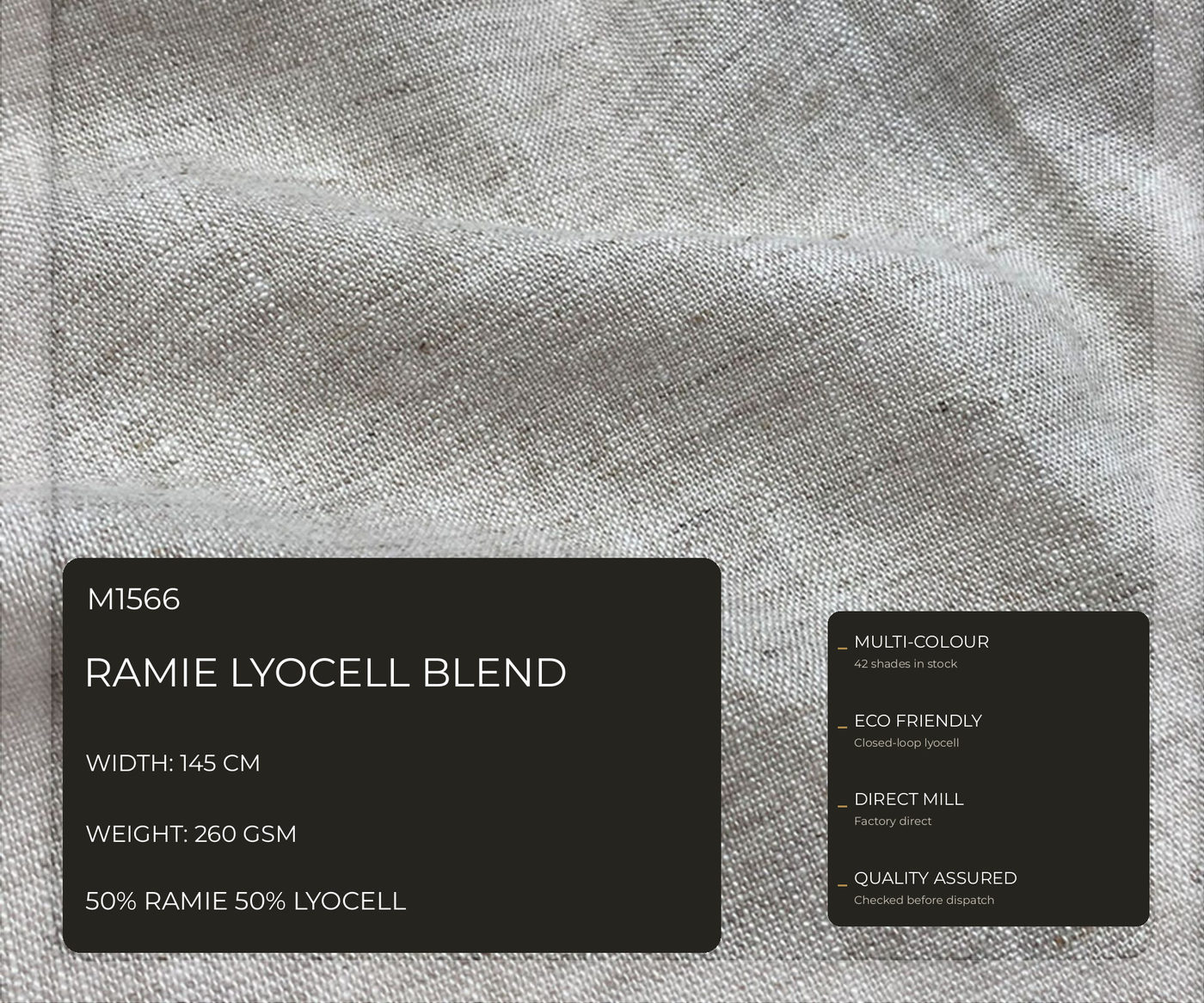
- 50% Ramie 50% Lyocell
- Weight
- 260 GSM
- Width
- 57 inches
- Weave
- Plain weave
- Category
- Linen Fabric Wholesale / Linen Solid Color Dyed Fabric / Woven
- MOQ
- Negotiable
Sampling & delivery
Build your sample selection, then download a sourcing brief. Ordering, stock and delivery will be enabled after the store information is confirmed.
FABRIC STORY
Product details
| SHAOXING HENGHUI TEXTILE CO., LTD. | ITEM NO. M1566 RAMIE-LYOCELL · 50% RAMIE 50% LYOCELL · 260 GSM |
Blend Fabric 50/50
145 CM
50% RAMIE
50% LYOCELL
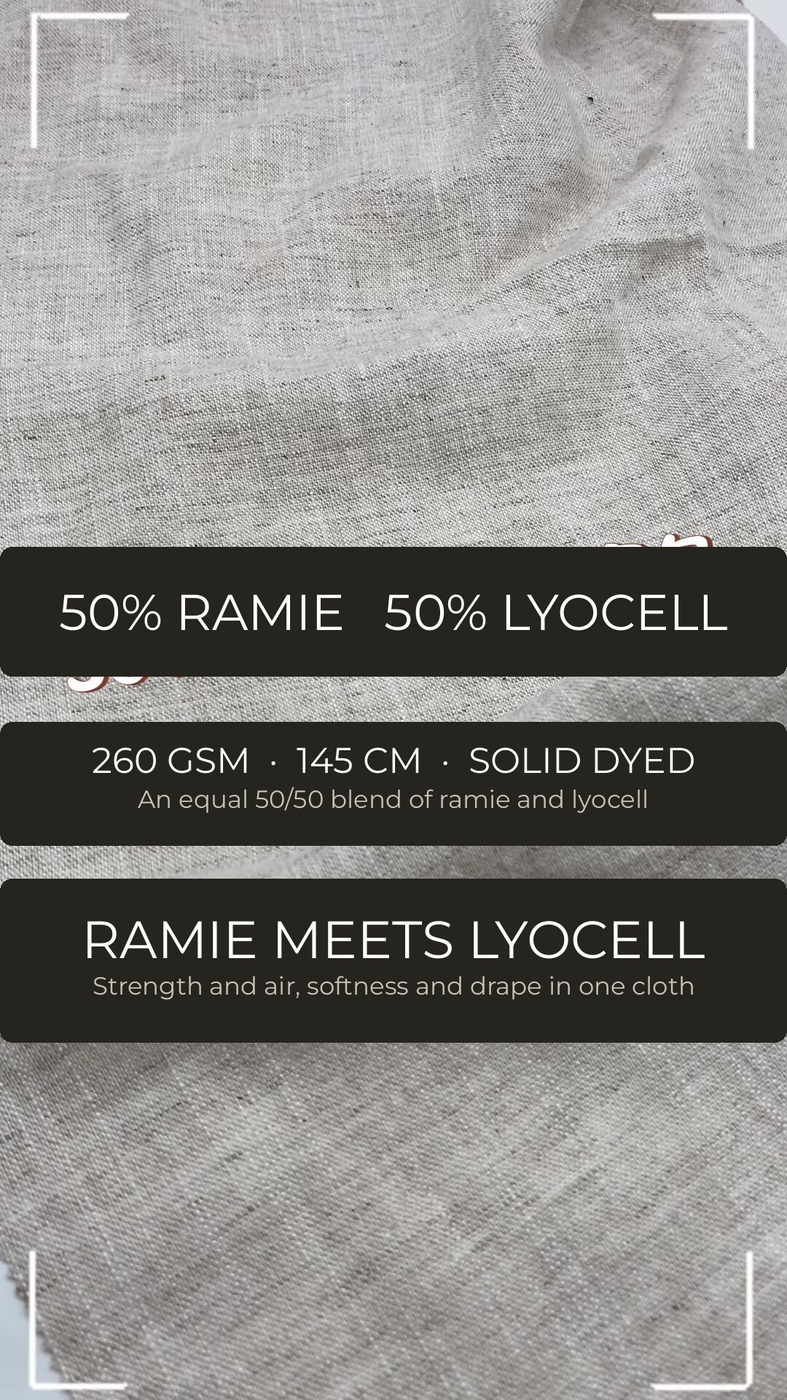
Item M1566 is a woven 50% ramie / 50% lyocell blend in solid dyed shades, finished at 260 GSM and 145 cm wide. Equal parts is not a compromise here — it is the working ratio for this pairing, and it is chosen because each fibre is fixing a specific weakness of the other. Pure ramie is strong, naturally crease-resistant and exceptionally breathable, but it is coarse, stiff, and its rough fibre ends can itch against the skin. Pure lyocell is smooth, cool and drapes beautifully, but on its own it can be too soft and lacks the support a garment needs to hold a line. At equal parts the ramie supplies the structure and the lyocell supplies the drape, and the result is a cloth that works across more garment types than either fibre could carry alone.
The complementary effect is measurable rather than a matter of marketing. Blended, this construction absorbs water roughly 25% faster than pure ramie, its wrinkle recovery runs about 40% better than pure lyocell, and the ramie fibres acting as a skeleton lift the abrasion count to roughly 1.8 times that of pure lyocell. Lyocell also brings markedly better color fastness than flax, which lifts water-wash fastness above grade 4 — the single most practical reason a ramie-led cloth stays looking right after a season of washing. At 260 GSM this is a light-tailoring weight: heavier than a shirt cloth, lighter than an outerwear suiting, and it holds a trouser or an unstructured jacket while still moving. 42 stock shades are held against the programme.
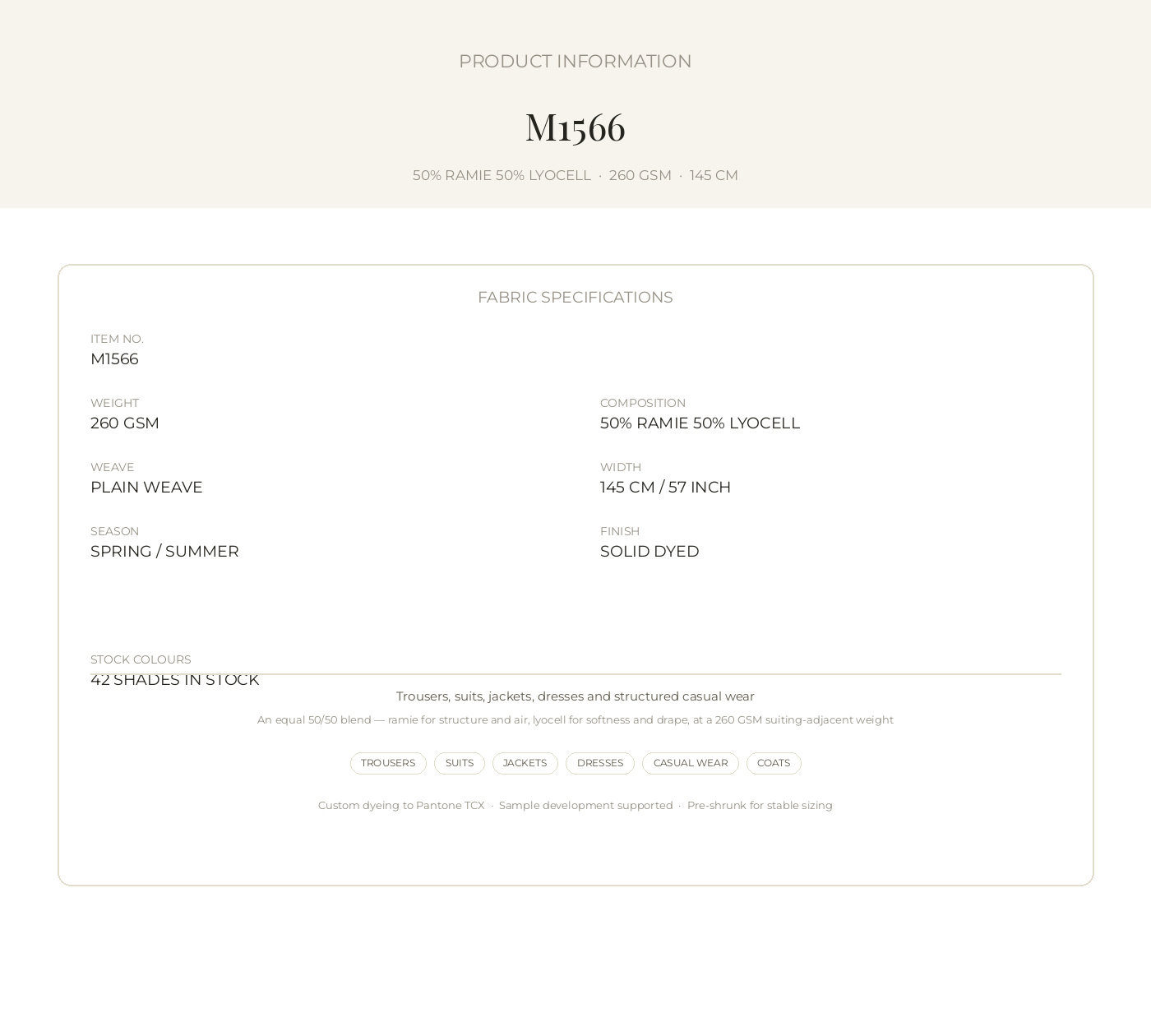
| Specification | Item M1566 |
| Item No. | M1566 |
| Composition | 50% Ramie, 50% Lyocell |
| Weight | 260 GSM |
| Width | 145 cm / 57 inch |
| Weave | Plain weave |
| Finish | Solid dyed |
| Season | Spring / Summer |
| Stock Colors | 42 shades in stock |
Five properties decide how this cloth behaves in wear. Because this is an equal-ratio two-fibre construction, the useful questions are how the two fibres work together, what the blend measurably does better than either alone, and where the honest limits are — because a regenerated cellulose in a natural-fibre cloth has its own care requirements.
Where this weight sits. At the heavy end of the range. There is enough body here to hold a line in a trouser or an unlined jacket, and enough weight for the cloth to hang rather than cling. That makes it the natural choice for trousers, jackets, structured dresses and tailoring — and the honest trade-off is that lyocell fibrillates under heavy wet friction, so it needs a gentle wash, and the ramie content still means the cloth will crease more than a pure lyocell.
Ramie and lyocell are normally blended in equal or near-equal proportions, and this is 50% ramie / 50% lyocell, which is the working ratio for this pairing. The reason is that each fibre is solving a specific problem with the other. Pure ramie is strong and naturally crease-resistant, but it is coarse, stiff, and its rough fibre ends can itch against the skin. Pure lyocell is smooth, cool and drapes beautifully, but it can be too soft and lacks the support a garment needs to hold a line. At equal parts, the ramie supplies the structure and the lyocell supplies the drape, and the result is a cloth that works across more garment types than either fibre could carry on its own. It is also a ratio that can be stated honestly on a label, because neither fibre is doing enough of the work to claim the garment.
The complementary effect is measurable rather than a matter of description, which matters when a buyer is comparing this against two pure-fibre options. Blended, this construction absorbs water roughly 25% faster than pure ramie, and its wrinkle recovery is around 40% better than pure lyocell. The ramie fibres act as a skeleton, which lifts the abrasion count to roughly 1.8 times that of pure lyocell. Lyocell also brings markedly better color fastness than flax, so the blend holds water-wash fastness above grade 4 — which is precisely what stops a ramie-led cloth from looking tired after repeated washing. These are not laboratory curiosities; they are the three things that decide whether a garment looks good after one season or after five.
Pure ramie is at its most vulnerable in the wash — it loses a substantial part of its strength when wet, and repeated laundering can leave it ragged. The lyocell component changes that: it raises the wet strength of a ramie-led cloth and makes the fabric more resistant to abrasion and tearing, so the cloth survives the cycle rather than the cycle surviving the cloth. On a 260 GSM cloth intended for trousers and suits, that is the difference between a garment that holds its shape across a season and one that goes soft at the knee and elbow. The practical instruction follows from the same fact: cold gentle wash, no rough drum load, and a line dry rather than tumble.
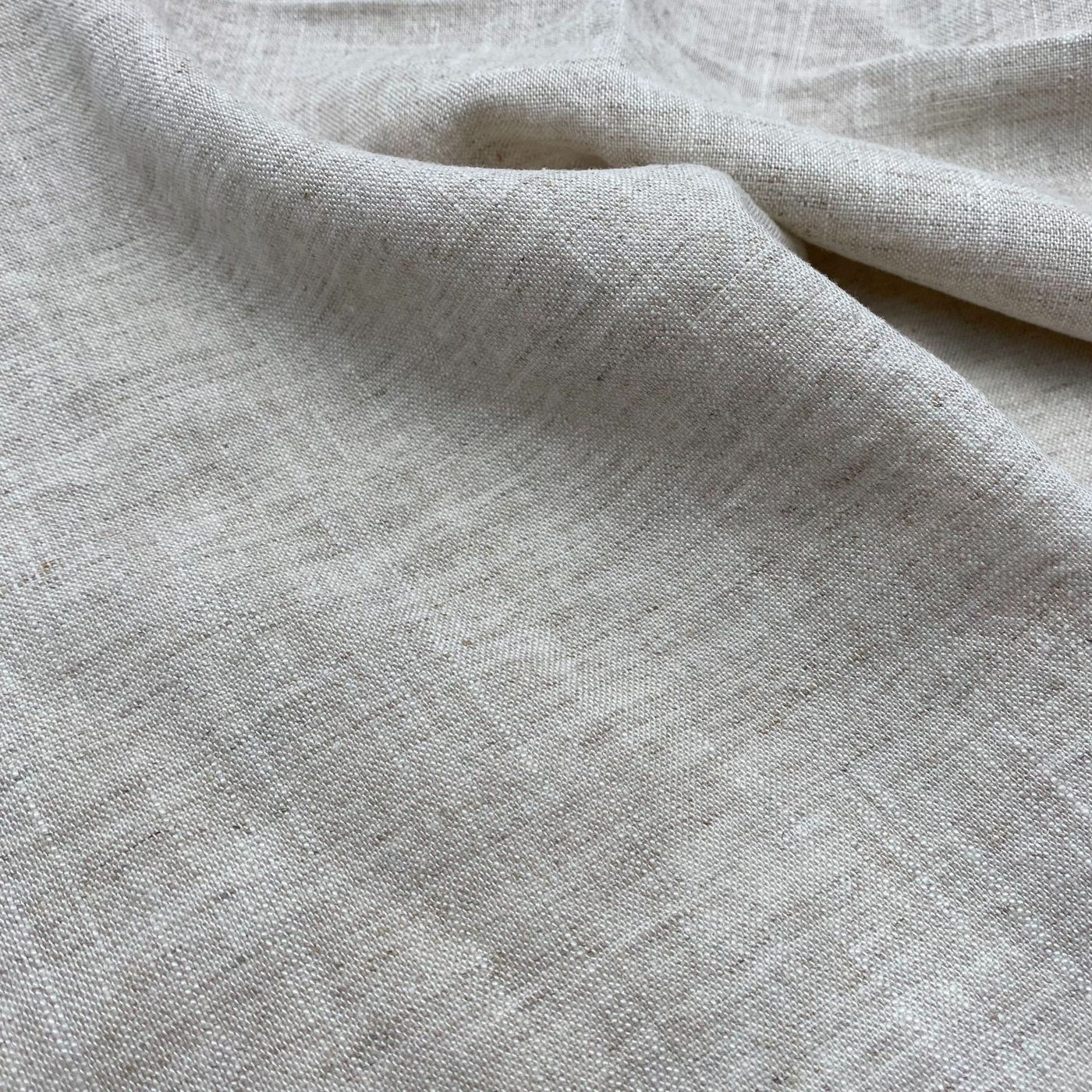
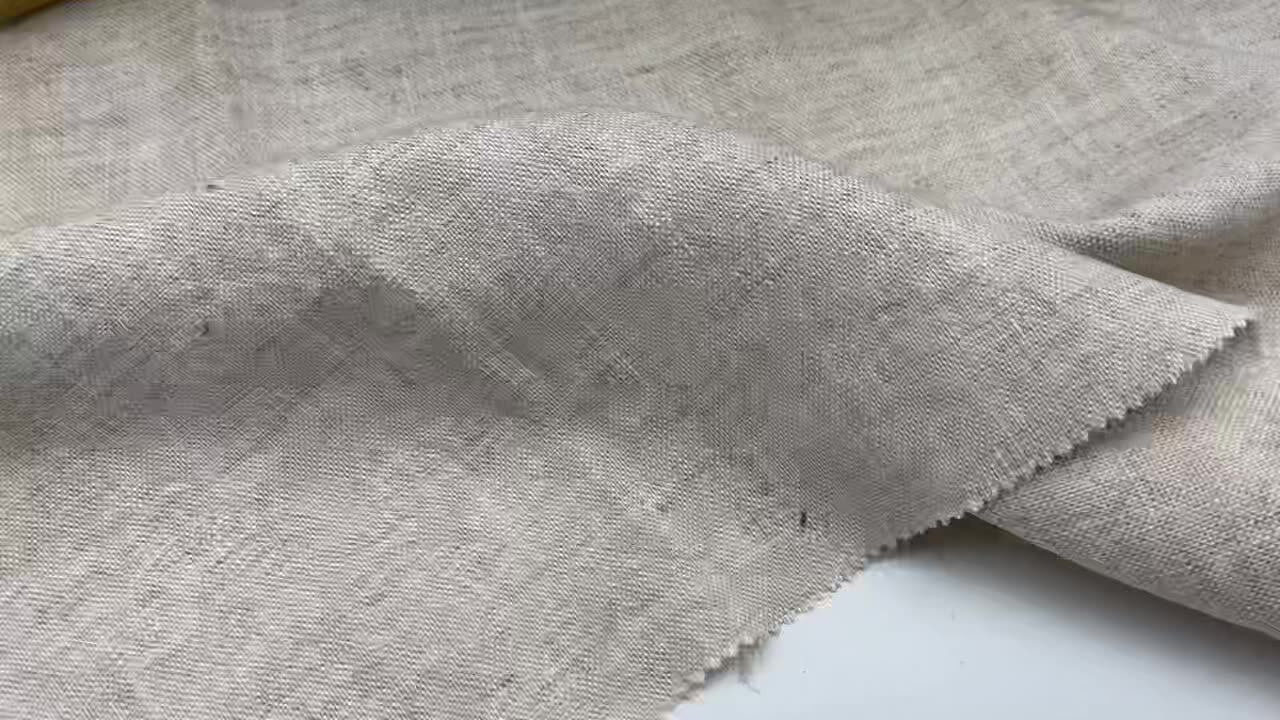
There is one more thing the lyocell does that is easy to overlook and hard to fake. The lyocell filament is smooth and round in cross-section, so it acts as a mechanical cushion over the coarse ramie fibre ends that cause the prickly feel in a pure ramie cloth. After sand-washing those ramie edges round off further, which is what allows the texture to stay completely intact while the irritation disappears. The result is a cloth that carries the visible character of ramie — the slight irregularity, the matte misty finish, the way it takes light — and can still be worn against bare skin. That combination is why this construction turns up in shirt-dresses and in suiting, sometimes in the same collection.
At 260 GSM this is a light-tailoring weight — heavier than a shirt cloth, lighter than an outerwear suiting — and it sits comfortably in a trouser, an unstructured jacket or a soft suit. Two limits are worth stating plainly. First, the lyocell component fibrillates: under heavy wet friction the fibre surface raises fine fuzz, and in the worst case it mats into pills. That is why this cloth asks for a cold hand wash or a gentle cycle, no soaking, no scrubbing and no tumble drying, and why deep shades should be washed separately. Second, the ramie content means the cloth still creases more than a pure lyocell — it simply creases with less severity and recovers faster. It also means the fabric is not a fully biodegradable natural cloth, because the lyocell is a regenerated cellulose produced in a closed-loop solvent process rather than a natural fibre. What it is: one of the most workable constructions in this range, with 42 stock shades held and a 145 cm width that gives efficient marker making across every garment type above.
At 260 GSM and 145 cm this is the weight that crosses from shirting into light tailoring, and the equal blend is what allows it to work in both. The ramie gives the cloth the structure to hold a shoulder line and a collar; the lyocell gives it the drape to fall from the waist and move at the hem. A brand developing a trouser-and-shirt range, or a shirt-dress with matching separates, can cover both from one specification.
This is the core use, and the reason for the weight. At 260 GSM the cloth has enough body to hold a wide-leg trouser away from the leg and to give a soft suit or an unstructured jacket a proper line, while the lyocell keeps the fall fluid rather than stiff. The 145 cm width gives efficient marker making across long panels, and because the blend holds its shape through the wash — the lyocell raises the wet strength that pure ramie loses most — a size approved on a washed sample stays close to the size that ships. That is what makes a repeat order land properly.
The same construction works for a shirt or a dress, and here the complementary effect shows up in a different way. The smooth, rounded lyocell filament physically cushions the coarse ramie fibre ends that cause the prickly feel in a pure ramie cloth, and after sand-washing those ramie edges round off further — so the texture stays completely intact while the irritation disappears. The result is a cloth that looks and reads as natural ramie, with the drape of a jersey and none of the stiffness, which is why it works for a shirt-dress, a loose shirt or a fluid skirt as well as for tailoring.
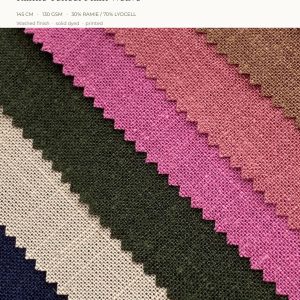
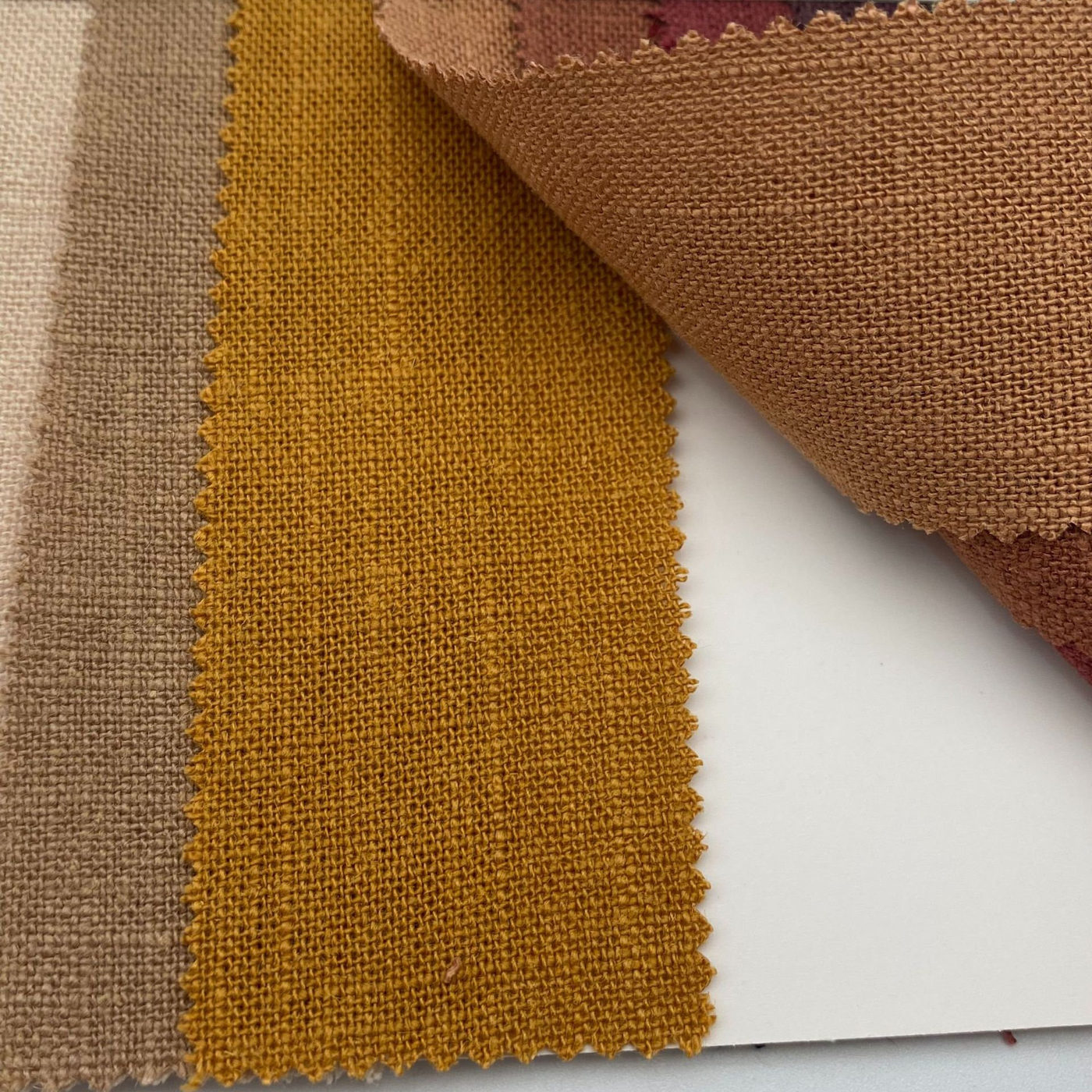
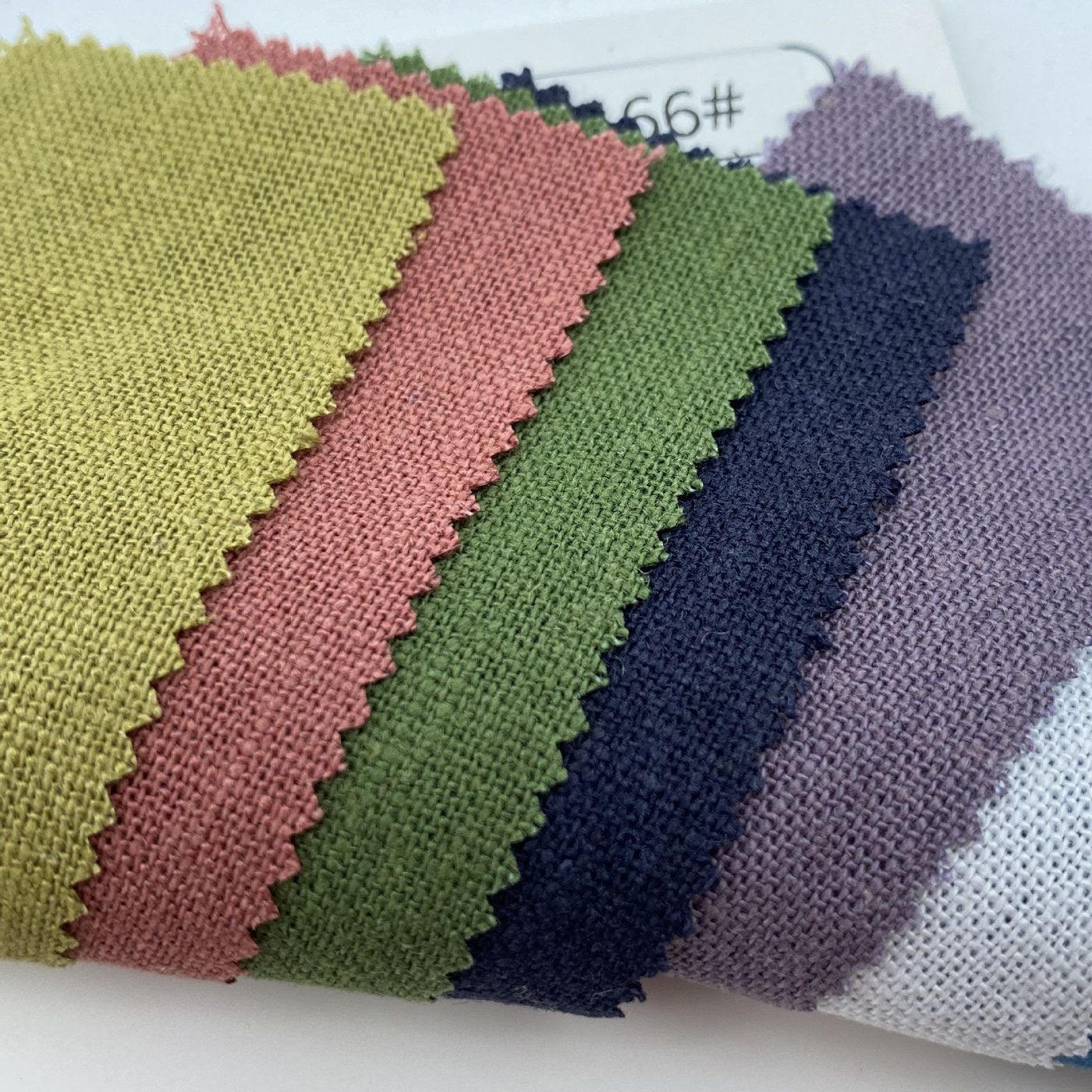
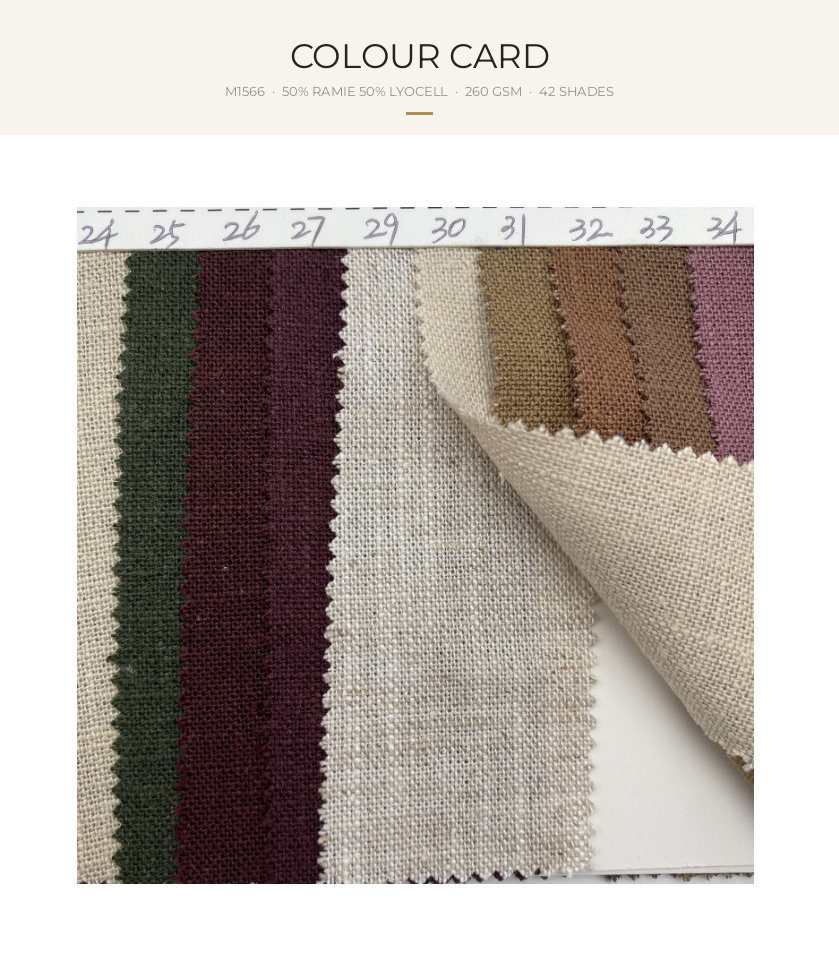
42 stock shades are held for immediate dispatch, running from naturals and ecru through olives, pinks, navies and deeper tones. The lyocell content gives the blend better color fastness than flax alone, holding water-wash fastness above grade 4, and the ramie keeps the surface reading as a natural cloth rather than a flat synthetic. Custom solid dyeing to Pantone TCX is available for development orders.
Hand samples and cutting samples are supplied before bulk production, either from stock greige or from a lab dip matched to your shade. For this blend we recommend sampling the finished cloth and washing it before approval: the ratio of the two fibres decides how the shade reads, and the washed result is the one the customer sees. Cut samples are supplied so the drape and the recovery can be judged on the body.
Development runs around three points: the fibre ratio and yarn count, the shade matched to Pantone TCX, and the weight confirmed against the end use. On a lyocell-led construction we also specify a gentle-wash route, because the fibrillation behaviour of lyocell under heavy wet friction is the one thing that will shorten the life of this cloth — cold wash, no soaking, no tumble drying, deep shades washed separately. We confirm shrinkage and dimensional stability on a washed sample before bulk is scheduled. Full-width greige and finished samples, small trial orders and custom development are supported for new customers.
| Service | Detail |
| Sampling | Hand sample and cutting sample before bulk |
| Lab dip | 3–5 shades against Pantone TCX or our own library |
| Greige | Full-width greige available on request |
| Development | Custom ratio, weight, width, finish and dyeing |
| Stock range | 42 shades held in stock |
| Production | Yongshun Dyeing & Finishing Plant |
| MOQ | Negotiable |
FABRIC ENQUIRY
Ask about this fabric
Share your requirements and our team will reply within 24 hours.