FAB-447673924
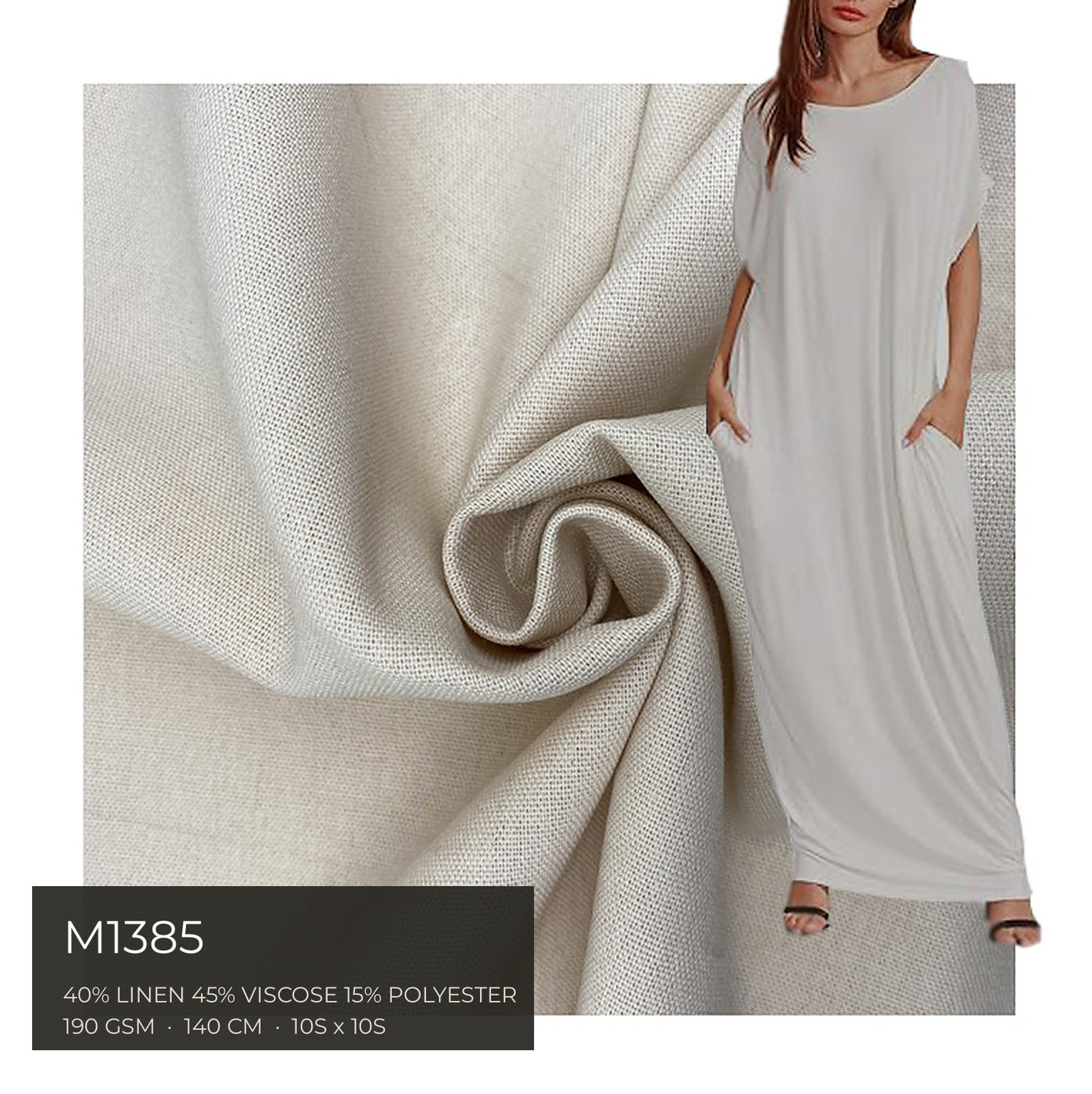
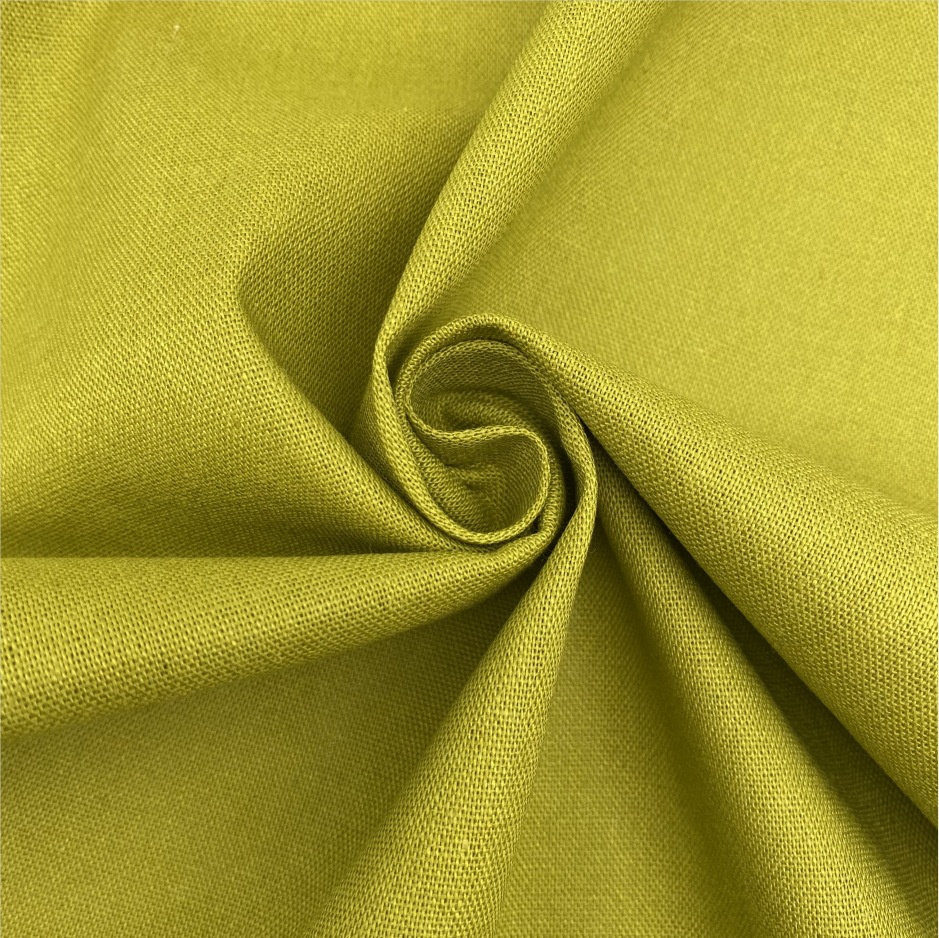
M1385 40% Linen 45% Viscose 15% Polyester Blend Fabric 10S 190 GSM 140cm Width – for Trousers, Shirts and Suits
Quote required
Contact us for the latest price and availability.
- Composition
- 40% Linen 45% Viscose 15% Polyester
- Weight
- 190 GSM
- Width
- 55 inches
- Weave
- Plain weave
- Category
- Linen Fabric Wholesale / Linen Solid Color Dyed Fabric / Woven
- MOQ
- Negotiable
Sampling & delivery
Build your sample selection, then download a sourcing brief. Ordering, stock and delivery will be enabled after the store information is confirmed.
FABRIC STORY
Product details
| SHAOXING HENGHUI TEXTILE CO., LTD. | ITEM NO. M1385 LINEN-VISCOSE-POLY · 40% LINEN 45% VISCOSE 15% POLYESTER · 10S · 190 GSM |
Polyester Blend Fabric 10S
140 CM
10S YARN
40% LINEN / 45% VISCOSE / 15% POLY
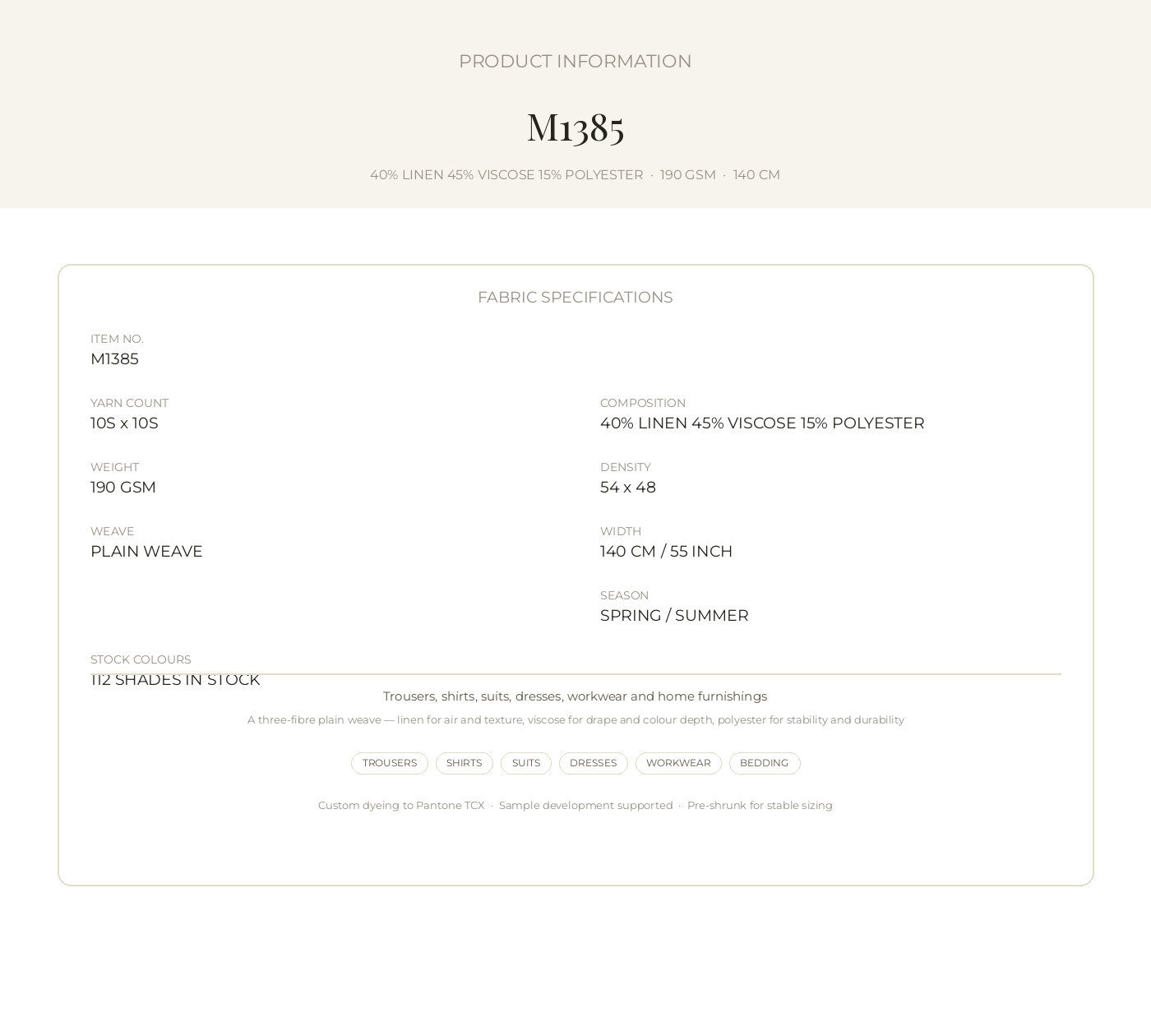
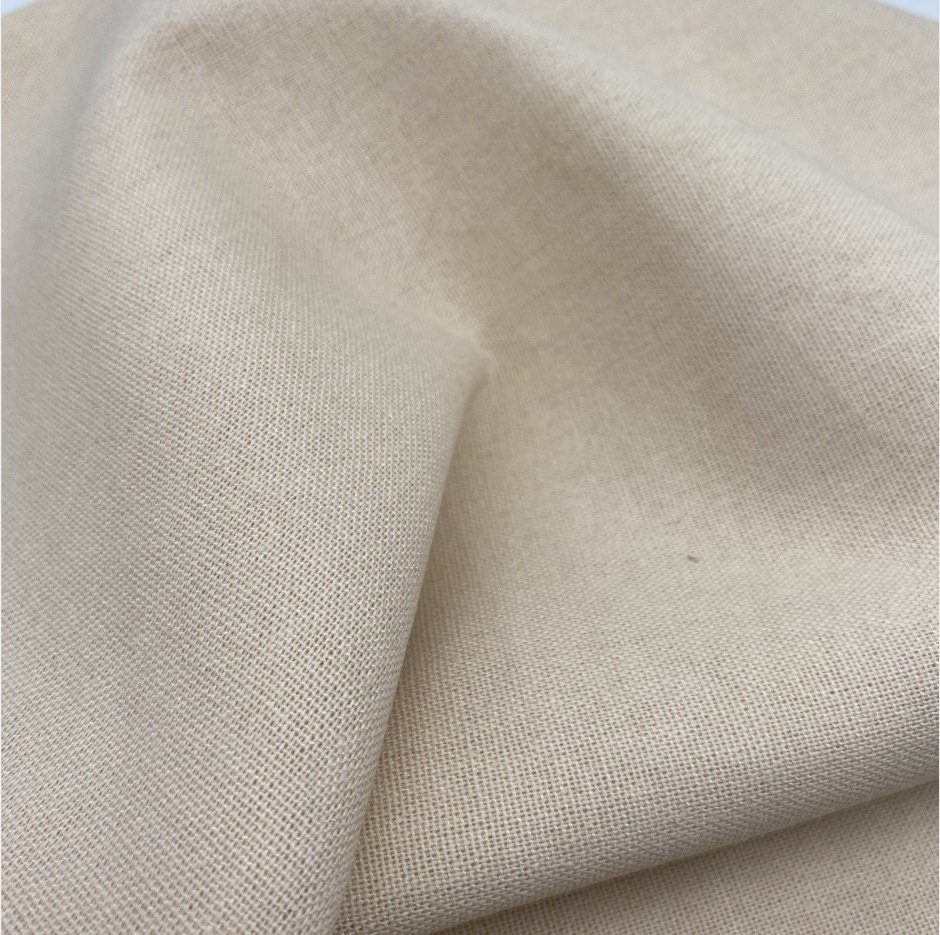
Item M1385 is a woven 40% linen / 45% viscose / 15% polyester blend — the 10s × 10s plain-weave construction at a 54 × 48 density, finished at 190 GSM and 140 cm wide in solid dyed shades. What distinguishes it from the usual two-fibre linen blend is the direction of the ratio: it is not linen diluted with a softener, and it is not a linen-polyester technical cloth either. It is a construction in which three fibres each do a different job — flax for airflow and natural texture, viscose for drape and color depth, polyester for shape retention and durability.
For a buyer this matters in three concrete places. Color is the first: flax is difficult to dye and holds color less reliably, which is why a plain-dyed pure linen can read slightly flat and slightly cloudy, while the same shade in a viscose-led blend reads clean and saturated. Shape is the second: the polyester share holds the dimensions through repeated washing, which is exactly where a viscose-led cloth normally goes slack. Wear is the third: at 190 GSM in a 54 × 48 density the cloth has enough body for a trouser that stands away from the leg, and enough abrasion resistance for a garment that gets washed often. At this weight it sits across the middle of the range — heavier than a summer shirting cloth, lighter than a suiting weight, and the point at which the construction crosses from shirting into light tailoring.
| Specification | Item M1385 |
| Item No. | M1385 |
| Composition | 40% Linen, 45% Viscose, 15% Polyester |
| Yarn Count | 10S × 10S |
| Density | 54 × 48 |
| Weight | 190 GSM |
| Width | 140 cm / 55 inch |
| Weave | Plain weave |
| Finish | Solid dyed |
| Season | Spring / Summer |
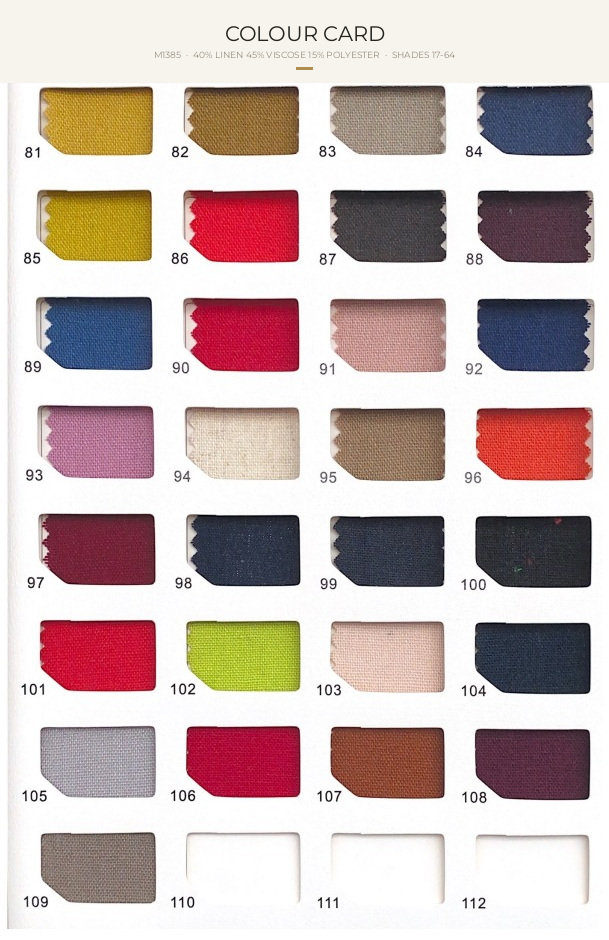
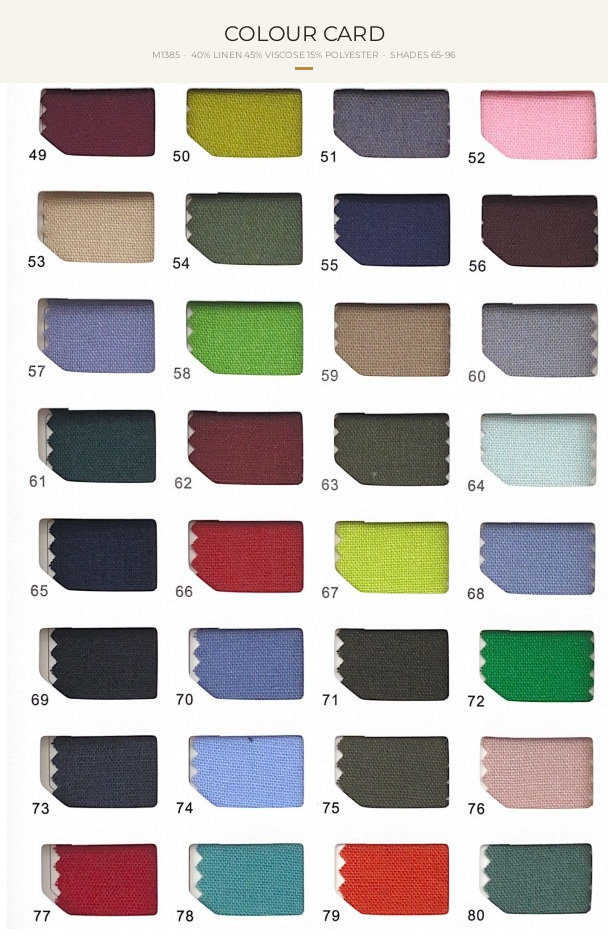
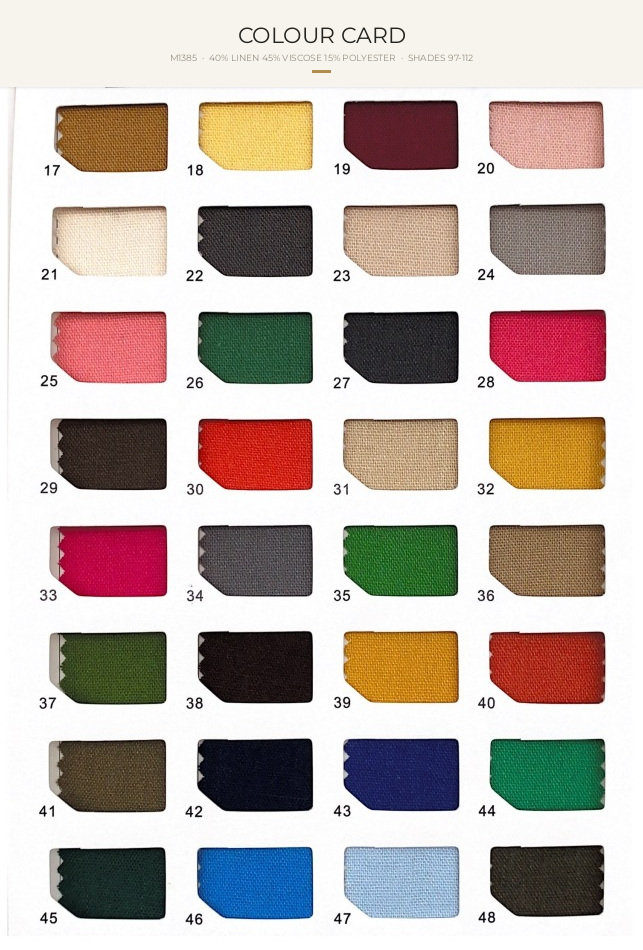
| Stock Colors | 112 shades in stock |
Five properties decide how this cloth behaves in wear. This is a three-fibre construction, so what matters is not what the blend is, but which fibre is carrying which part of the performance — and being honest about where the construction is weaker than a single-fibre cloth would be.
Where this weight sits. In the middle of the range, and the middle is where most linen apparel actually lives. Heavier than the 60–100 GSM cloths used for sheers and summer shirting, lighter than the 200+ GSM linens used for upholstery and heavy tailoring. That makes it the natural choice for shirting that stands away from the body, dresses and skirts that hold a shape, unlined jackets — and the honest trade-off is that the viscose component is weaker when wet, so it asks for a gentler wash than a pure or polyester-led cloth.
Most linen blends are a two-way compromise: linen traded against either softness or durability. This construction is different, because the ration is genuinely three-way. The 40% flax contributes the hollow-lumen structure that moves moisture away from the skin, the fine irregular surface texture and the matte absorbency. The 45% viscose contributes the fluid drape and the deep, even color. The 15% polyester contributes the dimensional stability, the abrasion resistance and the wrinkle behaviour that keep the cloth looking the same after the twentieth wash. Each fibre is doing a job the other two are poor at, which is what makes a three-fibre construction more useful to a buyer than a simple blend.
Flax is genuinely difficult to dye: it takes color unevenly across the fibre bundle and holds it less reliably than other cellulosics, which is why a plain-dyed pure linen can read slightly flat and slightly cloudy. Viscose is the opposite — it takes dye evenly, deeply and repeatably, and it is the reason this cloth reads clean and saturated in the same shade. The linen content is what stops the result looking synthetic: the fine irregular texture and the soft matte lustre stay visible through the dye. Where color consistency is the deciding factor for a brand — a core range that has to look the same season after season — this is the construction to specify.
Pure linen holds a sharp, papery fold and keeps it until the garment is worn or pressed again. The viscose in this cloth softens the fold, and the polyester adds the elastic recovery that lets it relax further as the garment moves. The result is a crease that forms but softens and settles rather than staying sharp and papery — noticeably more presentable at the end of a working day than a comparable pure linen, and the reason this construction works for a shirt or a trouser that has to be worn all day. It is not a no-press fabric, and we would rather say so than overclaim: it creases less than pure linen, and it lets go of those creases faster.
This is the quiet advantage of the polyester share, and for a buyer it is often the decisive one. Viscose fibres lose a substantial part of their strength when wet, and repeated washing can make a viscose-led cloth grow longer and go limp — a fabric that looks correct on the sample rack and shapeless after a season. The 15% polyester holds the dimensions through that cycle and resists abrasion in the places garments actually wear: the seat of a trouser, the shoulder under a bag strap, the cuff and the hem. Combined with a 10s × 10s yarn in a 54 × 48 density, this is a cloth that can be cut, sewn, washed and worn without the sizing problems that make buyers nervous about natural fibres.
Two things should be said plainly. First, the viscose component is weaker when wet, so this cloth asks for a cold, gentle wash and a line dry — hot washing and a rough drum load are what make a viscose-led fabric go slack, and this is the one thing that will shorten its life. Second, the polyester content reduces the pure natural character of the cloth: this is not a summer cloth for a brand whose whole position is on coolness and natural fibre, and it will not biodegrade. On pilling, the polyester share raises the risk of surface fuzzing in high-friction areas over time, so we would not put this fabric into a garment meant to be worn hard every day without a finish to control it. What it is — and this is a real position — is the most workable cloth in the range: drape, color depth, shape retention and washability in one construction, with the linen content at 40% and the polyester the smallest share, so the label can be honest about all three.
At 190 GSM and 140 cm this is the middle of the range and the middle is where most apparel actually lives. It is not a sheer summer voile and not an outerweight suiting cloth — it is the weight a buyer reaches for when one fabric has to cover trousers, shirts and unstructured jackets in the same delivery, and where the label has to state three percentages honestly.
This is the core use, and the reason for the weight and the width. At 190 GSM a 140 cm cloth has enough body to hold a wide-leg trouser away from the leg and to give a shirt a collar that stands without interfacing, while the viscose content lets both hang with a fluid line rather than a stiff one. The 140 cm width also gives efficient marker making for long panels, and because the polyester share holds the dimensions, the size approved on a washed sample is closer to the size that ships — which is the question that decides whether a natural-fibre programme gets repeat orders.
The soft hand and the fluid drape are what make this cloth work on a body rather than only in tailoring. A shirt-dress or a bias skirt made from it falls cleanly and moves with the wearer, and because the lyocell-equivalent viscose fibre is smooth and rounded there is no prickle against the skin — the usual objection to a linen blend in a warm climate. It also works as an overshirt over a summer dress, where a pure linen would be too crisp to layer. The viscose component is the one to watch on these pieces: it is weaker wet, so the garment wants a cold gentle wash and a line dry.
The third fibre earns its place here. The polyester share is what makes this cloth practical for anything that gets washed hard and often: it resists abrasion in the places garments actually wear — the seat of a trouser, the shoulder under a bag strap, the cuff and the hem — and it does not go limp the way a viscose-led cloth does after a season. Off the body the same construction suits bedding, cushion covers, table cloth and curtain cloth that has to hold its shape. At this weight it is furnishing-adjacent rather than true upholstery, and we would not put it into a heavily rubbed contract application without a surface finish.
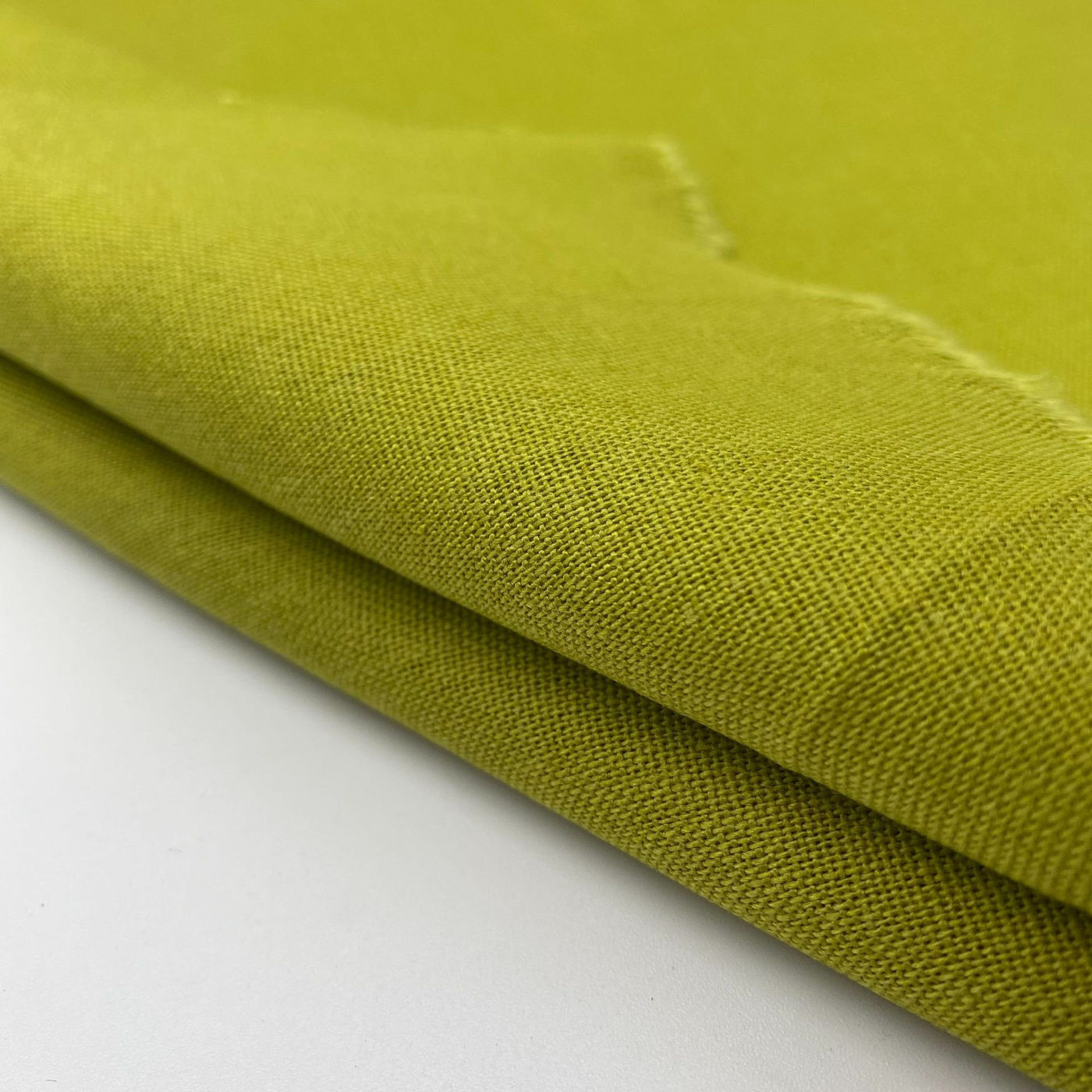
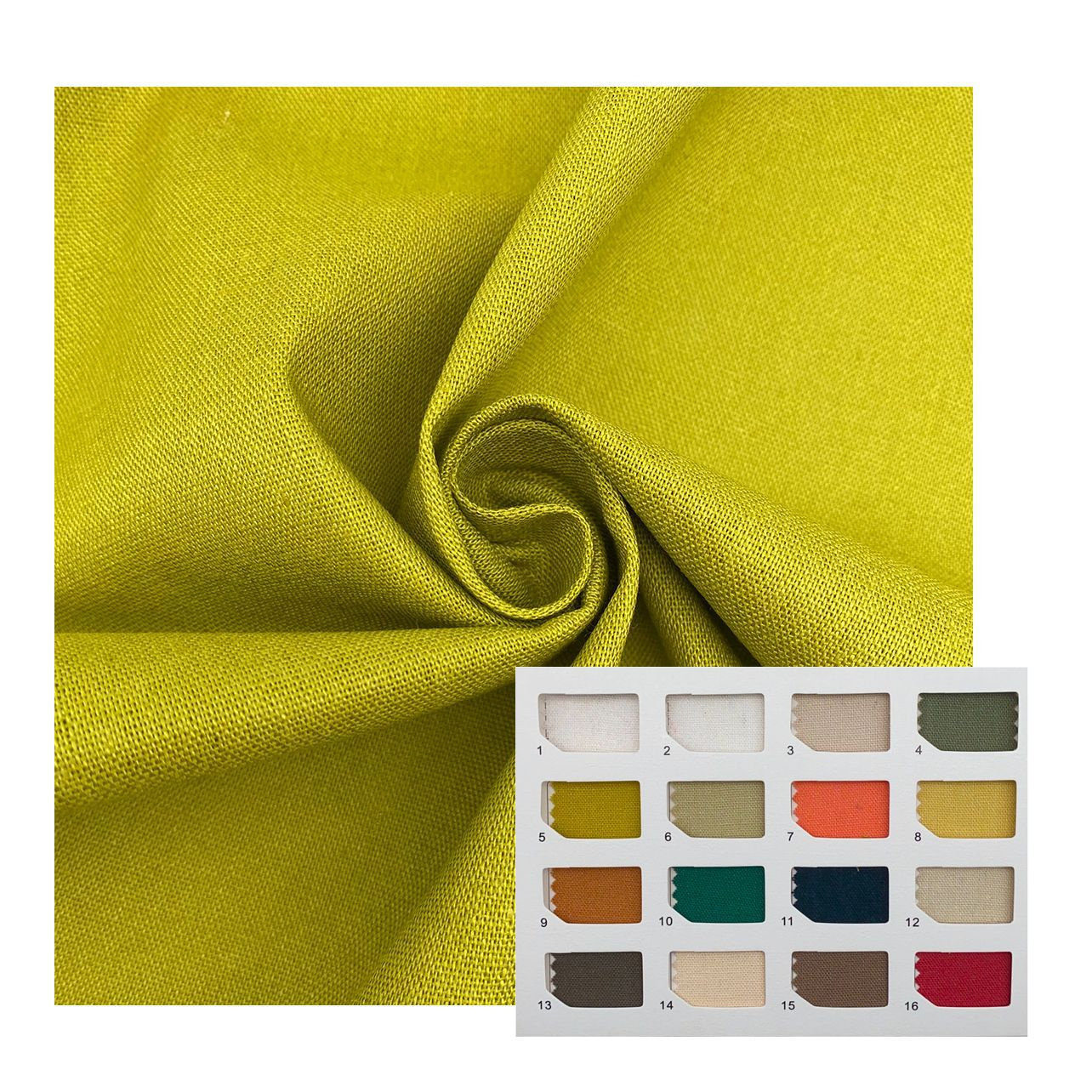
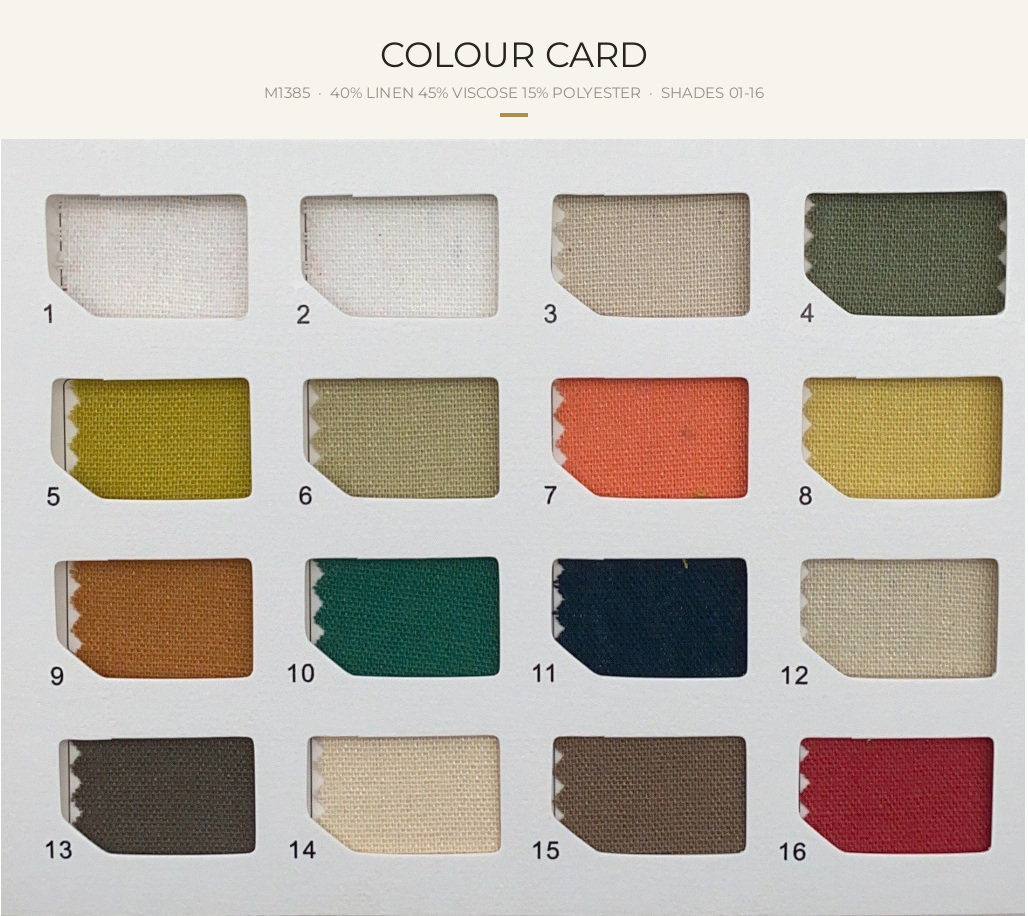
112 stock shades are held for immediate dispatch, running from naturals and whites through pastels, mid tones and deeper shades. The viscose content takes solid dye evenly and deeply, which is what makes a plain-dyed cloth in this construction read clean rather than cloudy — and custom solid dyeing to Pantone TCX is available for development orders.
Hand samples and cutting samples are supplied before bulk production, either from stock greige or from a lab dip matched to your shade. For a three-fibre construction we recommend sampling the finished cloth and washing it before approval: the balance between drape, hand and shape retention only settles after a wash cycle, and that is the property a buyer is really buying.
Development runs around three points: the fibre ratio and yarn count, the shade matched to Pantone TCX, and the weight confirmed against the end use. On a viscose-led blend we also confirm shrinkage and dimensional stability on a washed sample before bulk is scheduled, and we specify a gentle-wash route so the cloth keeps its shape through the life of the garment rather than only through the first season. Full-width greige and finished samples, small trial orders and custom development are supported for new customers.
| Service | Detail |
| Sampling | Hand sample or cutting sample before bulk |
| Lab dip | 3–5 shades against Pantone TCX or our own library |
| Greige | Full-width greige available on request |
| Development | Custom ratio, weight, width, finish and dyeing |
| Stock range | 112 shades held in stock |
| Production | Yongshun Dyeing & Finishing Plant |
| MOQ | Negotiable |
FABRIC ENQUIRY
Ask about this fabric
Share your requirements and our team will reply within 24 hours.