FAB-920238042
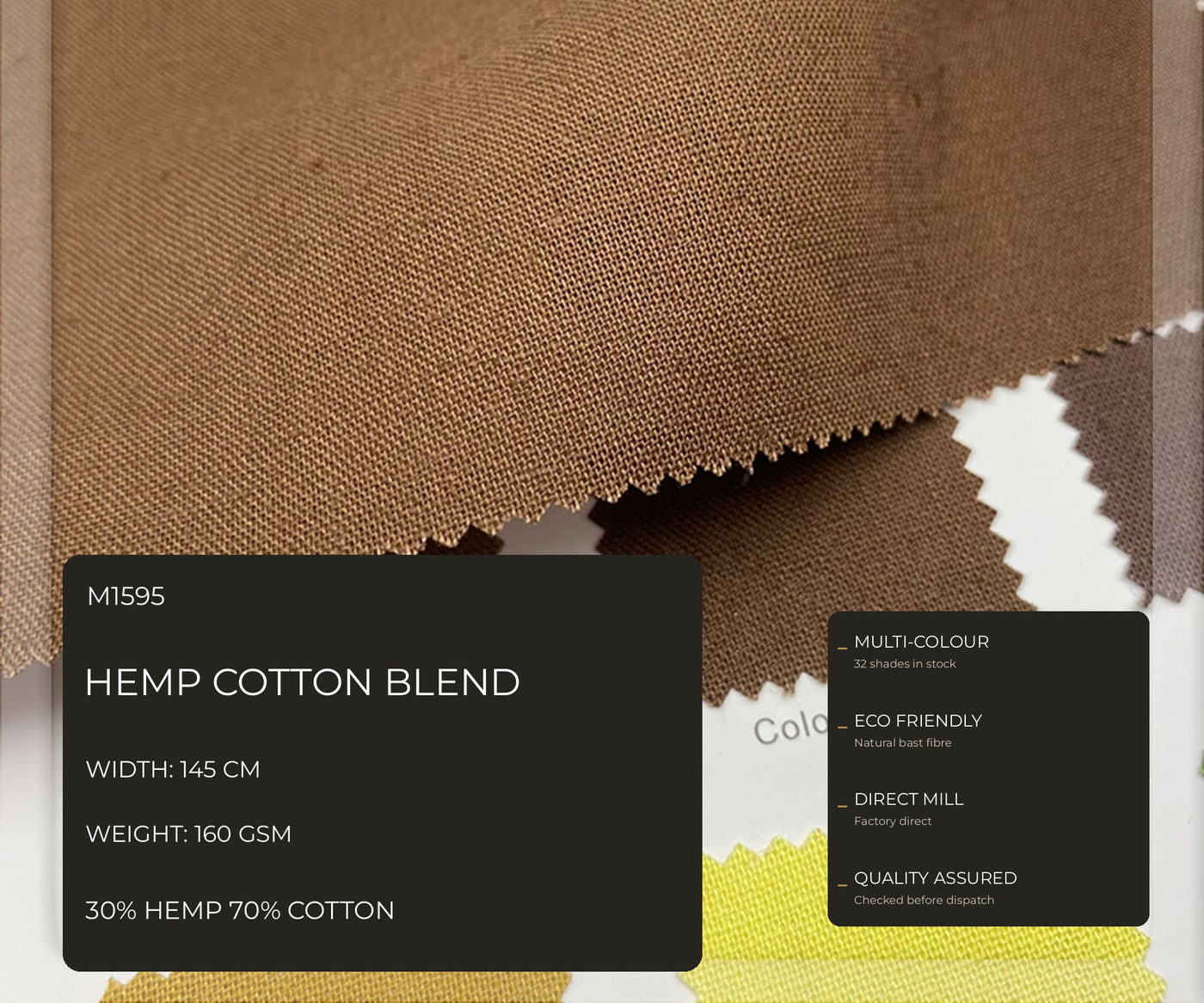
M1595 30% Hemp 70% Cotton Fabric 160 GSM 145cm Width – for Trousers, Shirts and Jackets
Quote required
Contact us for the latest price and availability.
- Composition
- 30% Hemp 70% Cotton
- Weight
- 160 GSM
- Width
- 57 inches
- Weave
- Plain weave
- Category
- Linen Fabric Wholesale / Linen Solid Color Dyed Fabric / Woven
- MOQ
- Negotiable
Sampling & delivery
Build your sample selection, then download a sourcing brief. Ordering, stock and delivery will be enabled after the store information is confirmed.
FABRIC STORY
Product details
| SHAOXING HENGHUI TEXTILE CO., LTD. | ITEM NO. M1595 HEMP-COTTON · 30% HEMP 70% COTTON · 160 GSM |
Blend Fabric 30/70
145 CM
30% HEMP
70% COTTON
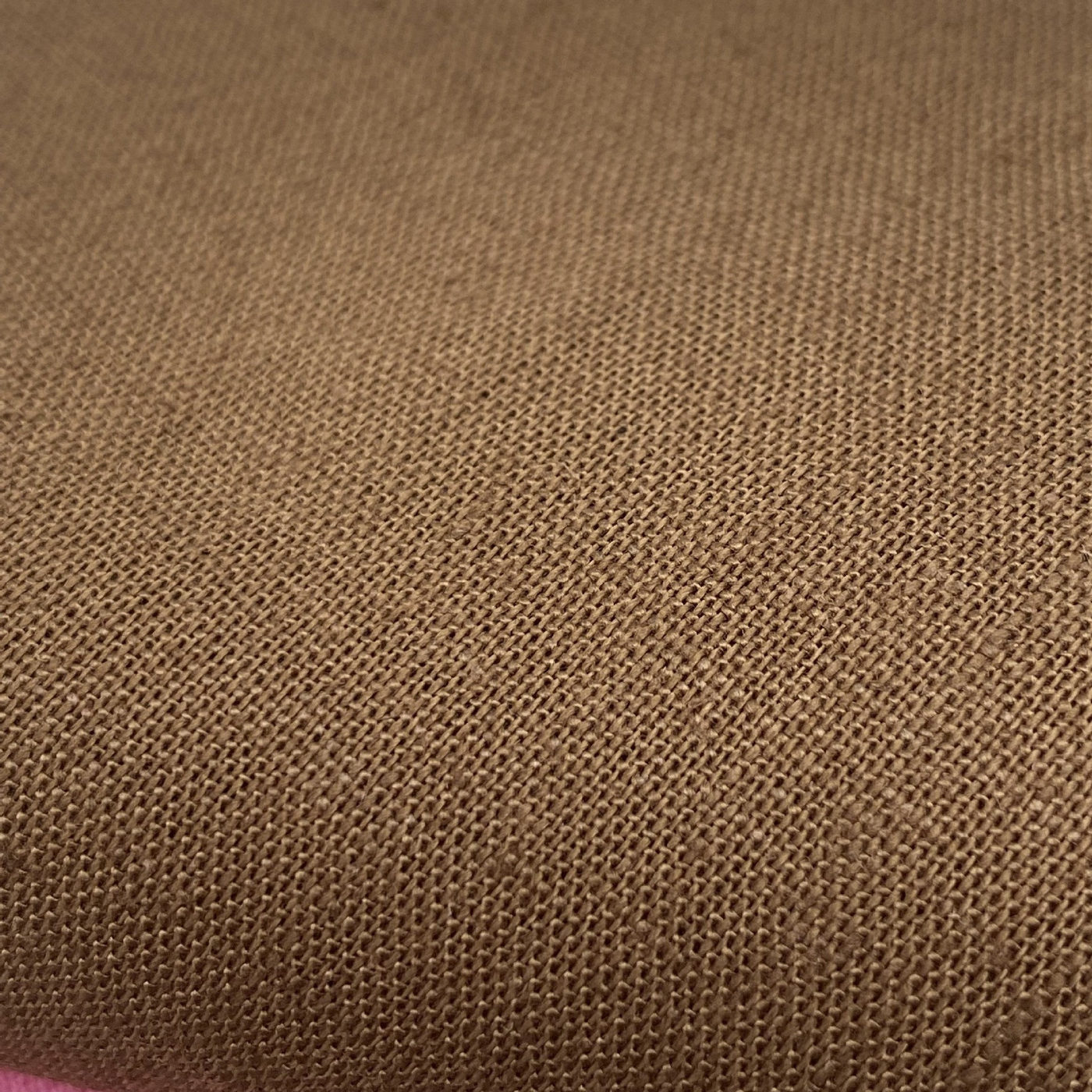
Item M1595 is a woven 30% hemp / 70% cotton plain weave at 160 GSM and 145 cm wide, supplied in solid dyed shades. Hemp and flax are both bast fibres, so hemp is often described as a linen substitute — it is not one, and the difference is worth stating. Hemp has a rounder, blunt-ended cross-section with a large central lumen and is finer and softer than flax, which is why it is comfortable against bare skin where linen can be prickly. Its tensile strength runs roughly three to four times that of cotton, and unlike cotton it gains strength when wet. The cotton carries the softness and the absorbency; the hemp carries the strength, the durability and the lowest environmental impact of any crop in this range.
The performance is measurable rather than claimed. Hemp has a moisture regain of about 12%, close to flax and well above cotton, and its capillary structure moves sweat away from the skin quickly, with measured absorption around twice that of cotton and a perceived temperature roughly 5°C lower than the equivalent cotton cloth. The fibre also carries natural phenolic compounds — hemp cannabinoids — giving it a measured bactericidal rate above 99%, the strongest of the four common bast fibres, plus natural UV shielding above 95%. In wear it is the most durable fibre here: excellent abrasion resistance, minimal pilling, no bending fatigue, and no natural stretch, which gives it excellent shape retention. 32 stock shades are held against the programme.
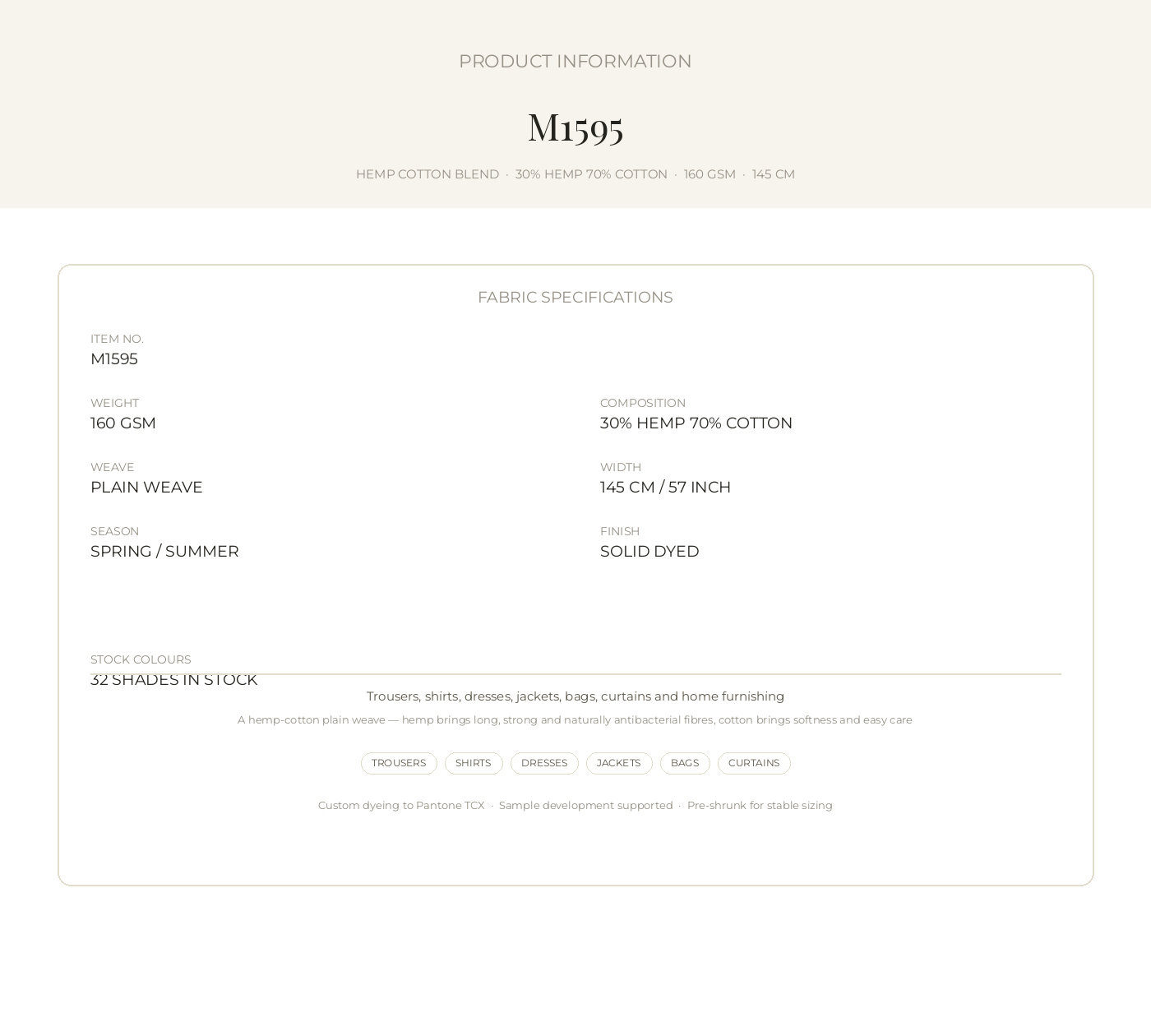
| Specification | Item M1595 |
| Item No. | M1595 |
| Composition | 30% Hemp, 70% Cotton |
| Weight | 160 GSM |
| Width | 145 cm / 57 inch |
| Weave | Plain weave |
| Finish | Solid dyed |
| Season | Spring / Summer |
| Stock Colors | 32 shades in stock |
| Applications | Trousers, shirts, dresses, jackets, bags |
Five properties decide how this cloth behaves in wear. Because the construction is defined by a fibre that most buyers know by reputation rather than by specification, the useful questions are what hemp actually does differently from flax, what the measured figures are, and what the honest limits are.
Where this weight sits. In the middle of the range, and the middle is where most linen apparel actually lives. Heavier than the 60–100 GSM cloths used for sheers and summer shirting, lighter than the 200+ GSM linens used for upholstery and heavy tailoring. That makes it the natural choice for shirting that stands away from the body, dresses and skirts that hold a shape, unlined jackets — and the honest trade-off is that hemp wrinkles readily like any bast fibre, and new hemp cloth has a firm hand that softens over the first two or three washes.
Hemp and flax are both bast fibres, so hemp is often described as a linen substitute. It is not one, and the difference matters. Hemp has a rounder cross-section with a blunt tip and a large central lumen, and it is finer and softer than flax — which is why hemp is described as comfortable against bare skin where linen can be prickly. In tensile strength hemp runs roughly three to four times that of cotton, and unlike cotton it gains strength when wet, so it is one of very few natural fibres that holds up better after washing rather than worse. At 30% hemp and 70% cotton this construction places that performance inside a cloth that is still soft, absorbent and easy to wear from the first day.
These three properties are what a buyer is actually buying when they choose hemp, and all three are measured rather than claimed. Hemp has a moisture regain of about 12% — close to flax and well above cotton — and its capillary structure moves moisture away from the skin quickly, with measured absorption around twice that of cotton; wearers report a perceived temperature roughly 5°C lower than the equivalent cotton cloth. The fibre also carries natural phenolic compounds — hemp cannabinoids — which give it a measured bactericidal rate above 99%, the strongest of the four common bast fibres and the reason hemp appears in socks, underwear and activewear. It adds natural UV shielding above 95% and very high heat resistance on top of that.
Hemp is one of the few textile crops that actively improves the ground it grew in. Its taproot loosens compacted subsoil and its leaf drop returns biomass to the field, which is why it is used as a remediation crop on land exhausted by other planting. It requires almost no synthetic pesticide, because it is naturally resistant to most insect pests, and it suppresses weeds by growing densely enough to shade them out. Industry estimates put hemp water use at roughly half that of cotton, and it yields more fibre per hectare than either cotton or flax. None of that requires the buyer to compromise on the cloth: the cotton carries the softness and the hemp carries the strength and the lower footprint, which is why this blend is a practical route to a more sustainable apparel and home-textile cloth without asking anyone to give up the hand.
In wear, hemp behaves better than almost any other plant fibre. Because of its long staple and robust cell wall it has excellent abrasion resistance, and in a 20,000-cycle Martindale test hemp blends tend to hold fibre integrity where softer regenerated fibres start to break down around 8,000 to 12,000 cycles. It pills minimally — the long fibre length and high tenacity resist the fuzzing that produces pills — and unlike linen it does not suffer from bending fatigue, which is what makes linen garments thin at the stress points over time. It also does not stretch: it lacks natural elasticity, which gives the cloth excellent shape retention and makes it a good choice for a trouser, a bag panel or a cushion cover that has to hold its form.
Three points stated plainly. First, hemp wrinkles — it is a bast fibre and it creases, though the fibre rigidity means the creases are less severe and recover better than linen’s, and a 30/70 blend improves on both. Second, new hemp cloth has a firm hand, closer to canvas than to jersey; the stiffness comes from residual lignin and pectin at the fibre surface and it diminishes over two to three normal wash cycles, so it is worth washing the sample before approving it. Third, hemp is more expensive than cotton — typically two to three times the cost of an equivalent weight — because production is smaller, retting and decortication are labour-intensive, and there are fewer mills running it at scale. Shrinkage is the good news: untreated hemp runs 3 to 5% on the first wash, and pre-shrunk cloth is held below 2%, against 5 to 10% for untreated cotton. What this cloth is: 32 stock shades of a 160 GSM plain weave with the strength of hemp, the softness of cotton and the lowest-impact crop in this range.
At 160 GSM and 145 cm this is a mid-weight cloth that crosses from shirting into light tailoring, and the hemp content is what makes it suitable for pieces that take wear. The 145 cm width gives efficient marker making for long panels, which is what makes one specification usable across several garment types.
This is the core use, and the reason for the weight. At 160 GSM the cloth has enough body to hold a wide-leg trouser away from the leg and to give a shirt a collar that stands, while the cotton content keeps it soft and absorbent against the skin. What hemp adds is durability where it counts: because it has no natural stretch, the cloth holds its shape through wear, and because it does not suffer the bending fatigue that thins linen at stress points, it stays strong at the knee, the elbow and the cuff. For a garment intended to be worn hard, that is the argument for hemp over linen.
The same cloth works for a dress or a skirt, and here the thermal performance is what carries it. With absorption around twice that of cotton and a measured moisture regain of about 12%, the cloth moves perspiration away from the body and lets it evaporate rather than holding it against the skin; wearers report a perceived temperature roughly 5°C below the same weight in cotton. The antibacterial rate above 99% is also relevant here, because it means a dress or a shirt cut from this fabric does not hold odour over a long day.
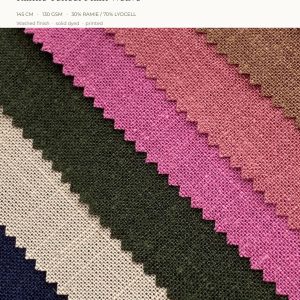
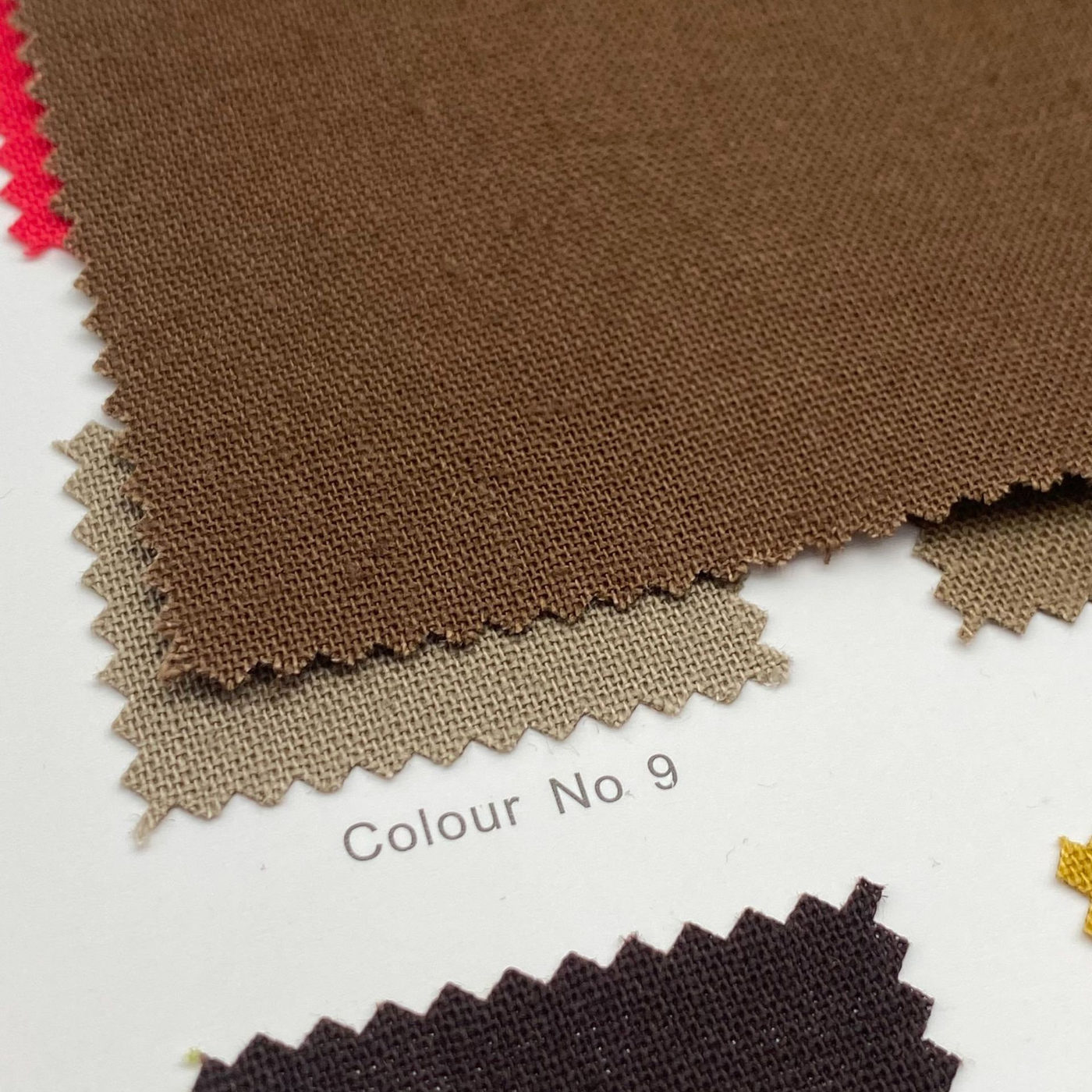
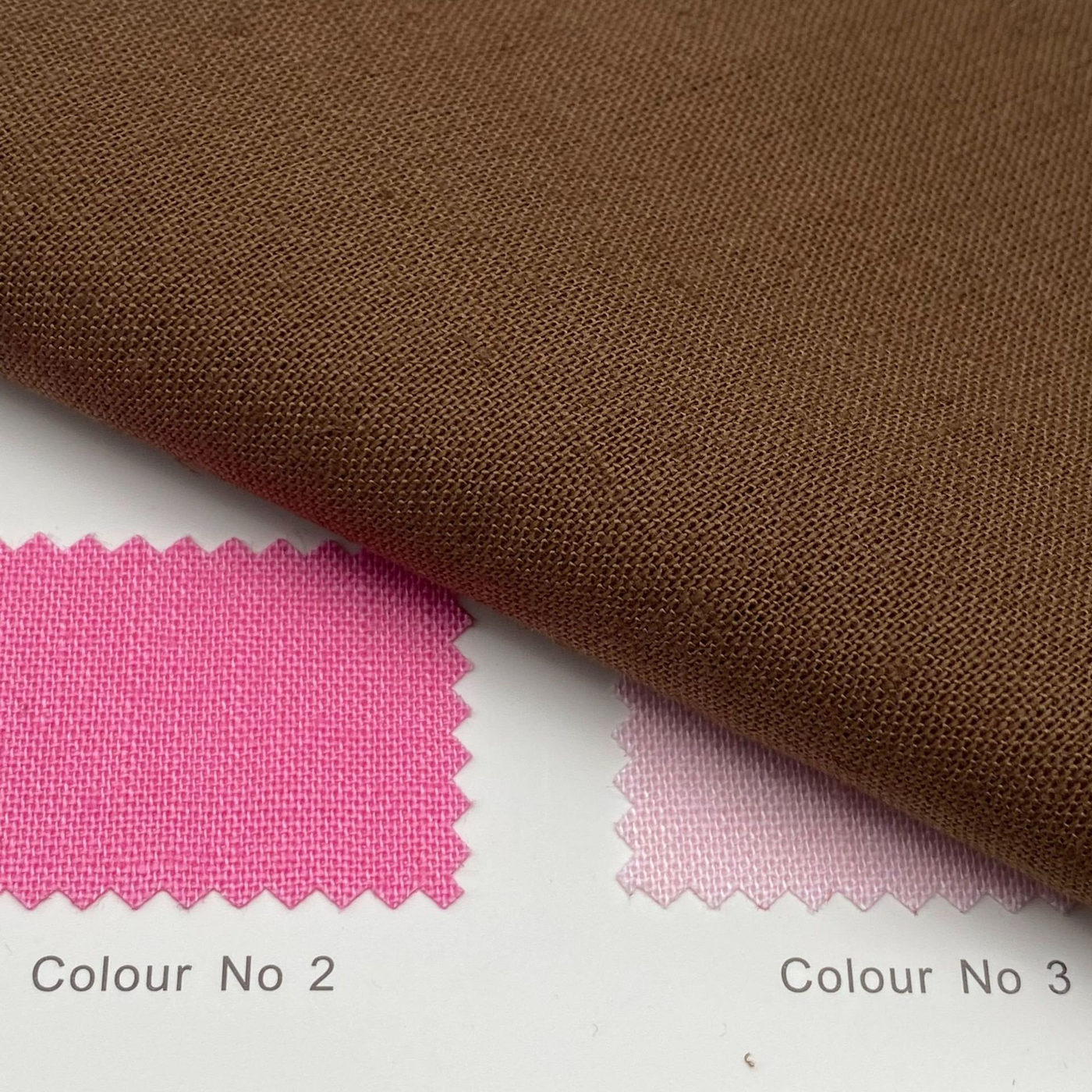
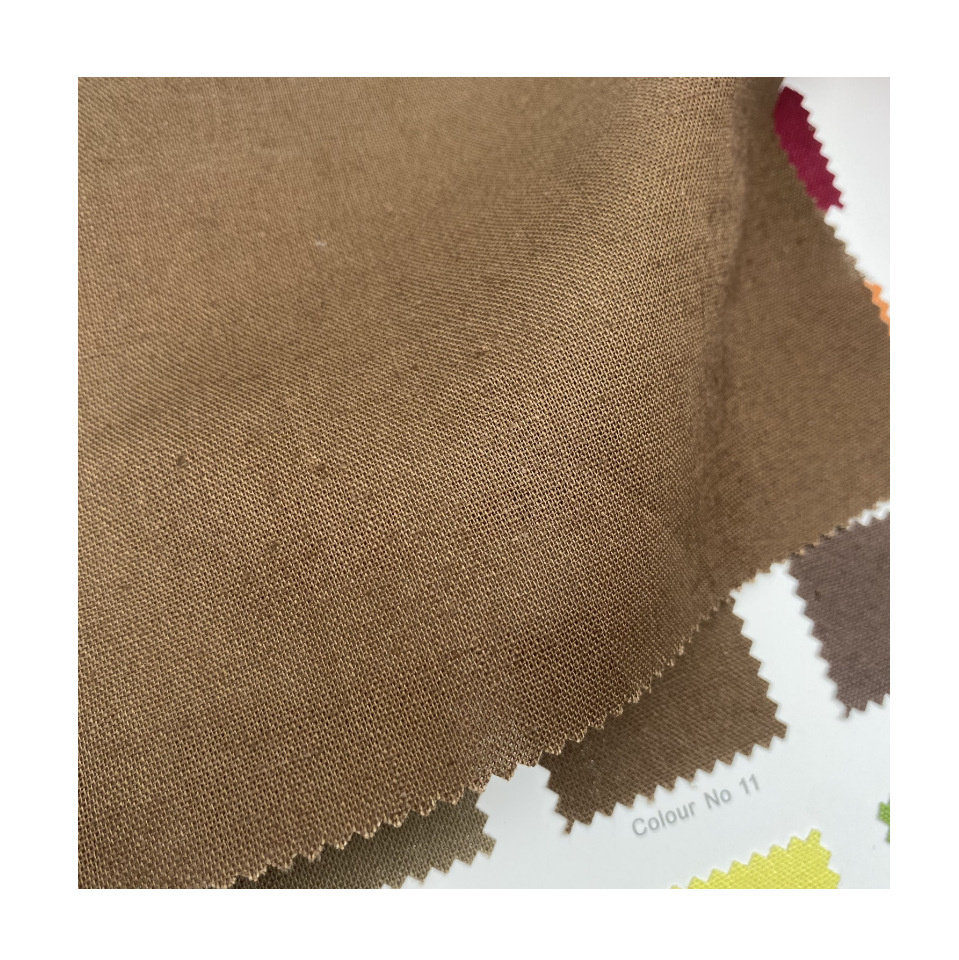
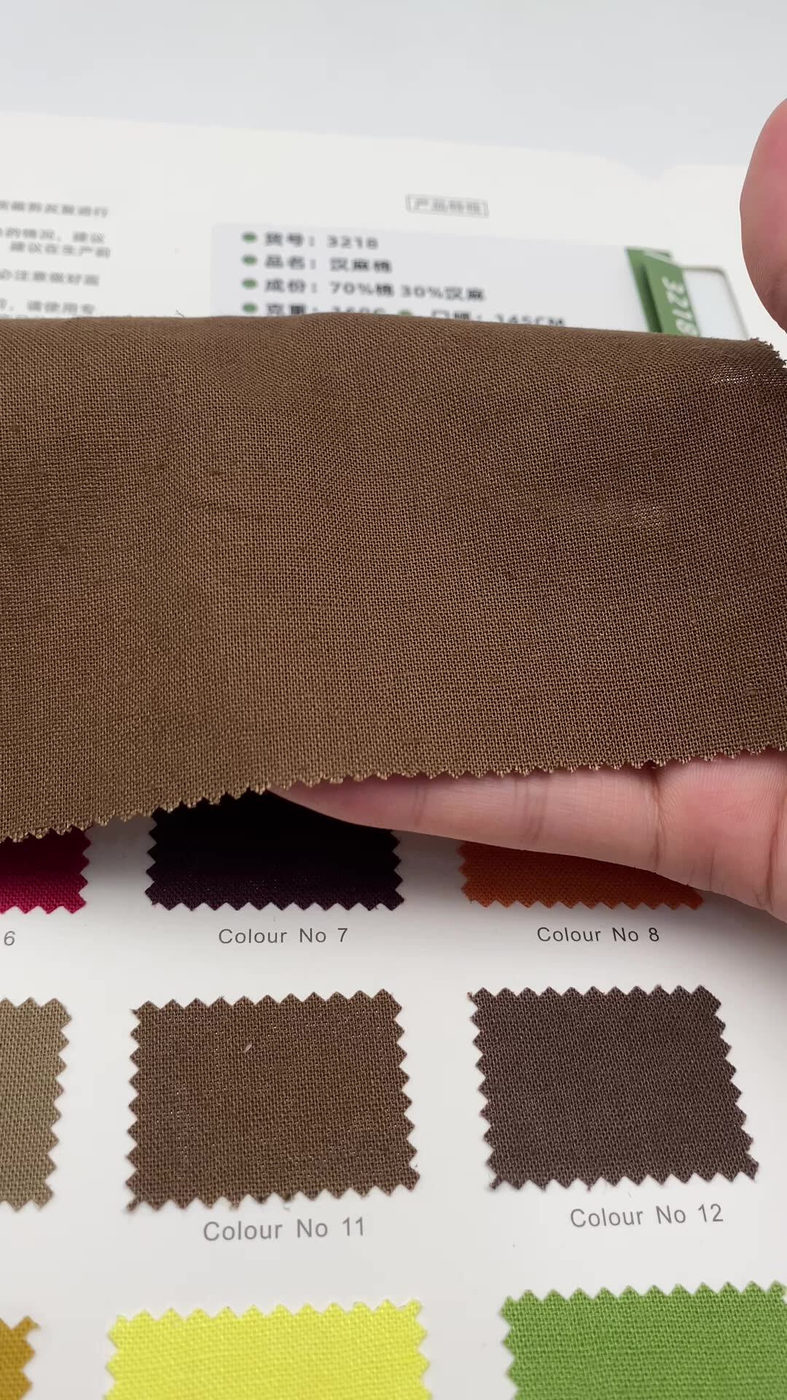
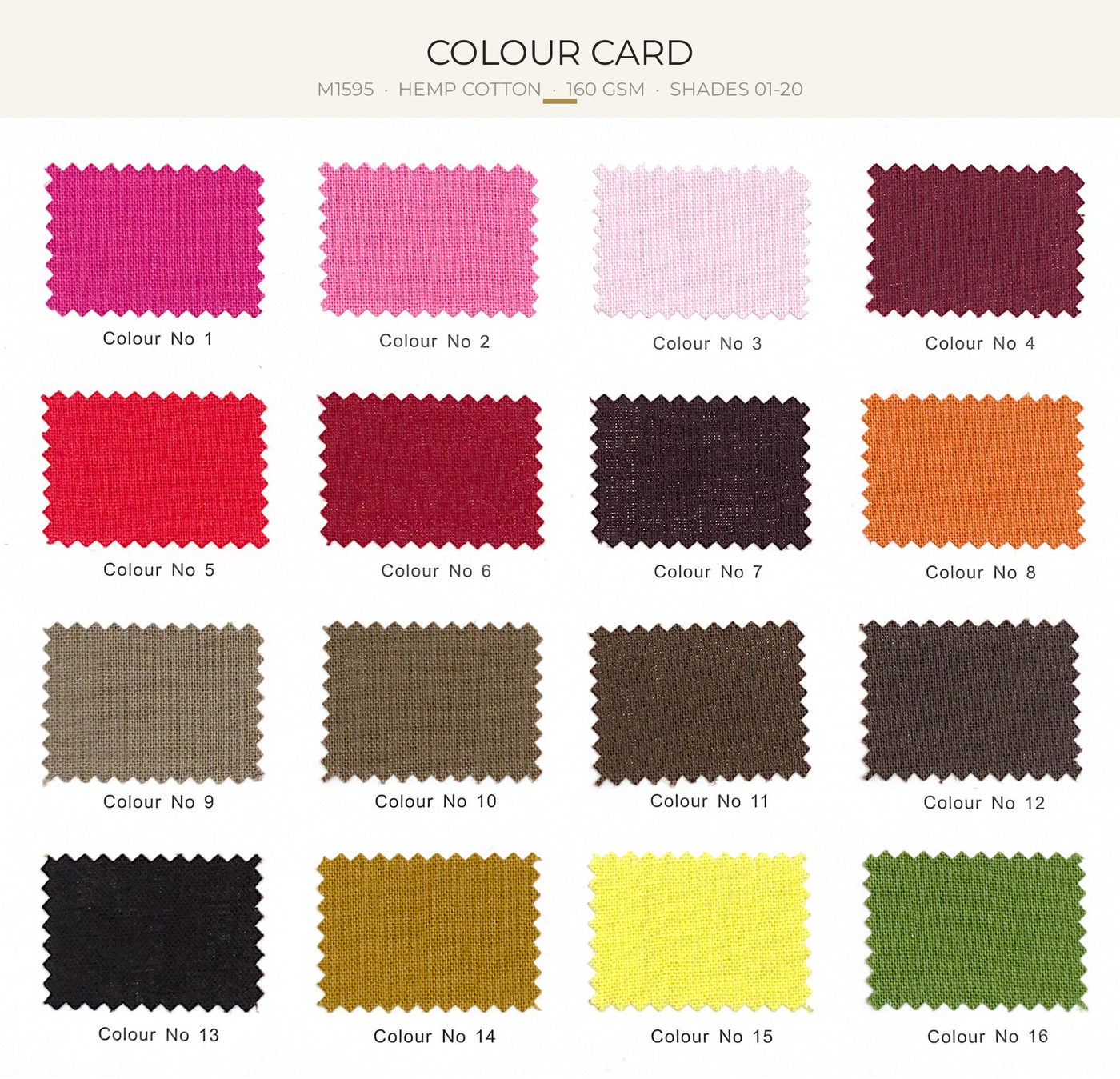
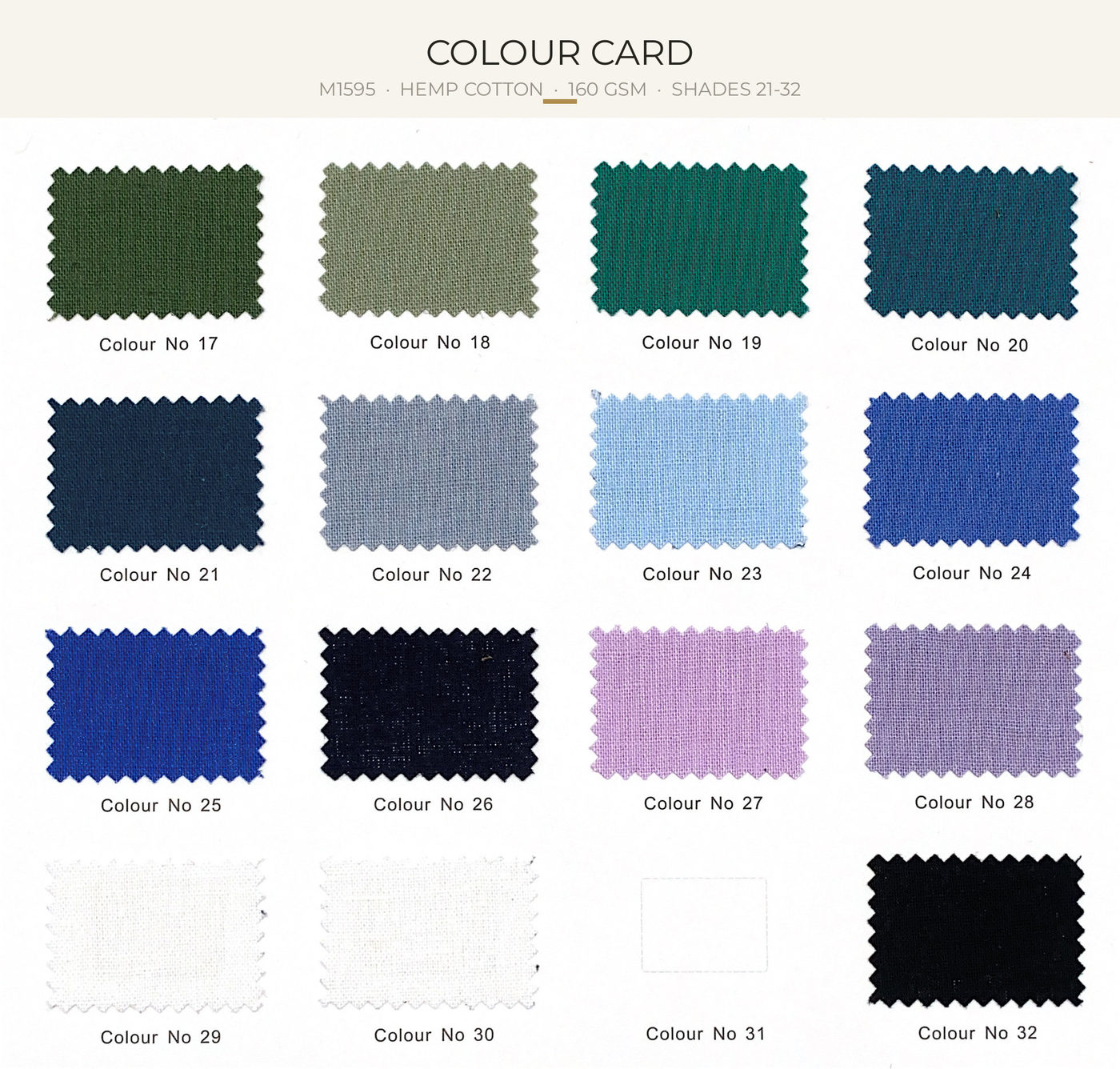
32 stock shades are held for immediate dispatch, running from naturals and creams through olives, dusty pinks and deeper tones, shown here across two full color card pages. Custom solid dyeing to Pantone TCX is available for development orders. One note for anyone approving a shade on a hemp construction: hemp takes dye readily and holds it well, but the phenolic compounds in the fibre can shift a color very slightly in the first wash, so the shade should be confirmed on a washed sample rather than on the greige.
Hand samples and cutting samples are supplied before bulk production, either from stock greige or from a lab dip matched to your shade. For a hemp construction we strongly recommend washing the sample before approval: new hemp cloth has a firm hand that comes from residual lignin and pectin at the fibre surface, and that firmness lifts noticeably over two or three normal wash cycles. Approving the unwashed hand is the most common way a hemp order disappoints.
Development runs around three points: the fibre ratio and yarn count, the shade matched to Pantone TCX, and the weight confirmed against the end use. Because hemp is a bast fibre, it wrinkles like linen and wants gentler laundering than cotton — we specify a cold or warm wash, no high-temperature tumble, and a line dry, and we would avoid chlorine bleach, which damages cellulose fibres. On a hemp construction we also confirm the shade on a washed sample, because the natural phenolic compounds can shift a color very slightly in the first wash. Full-width greige and finished samples, small trial orders and custom development are supported for new customers.
| Service | Detail |
| Sampling | Hand sample and cutting sample before bulk |
| Lab dip | 3–5 shades against Pantone TCX or our own library |
| Greige | Full-width greige available on request |
| Development | Custom ratio, weight, width, finish and dyeing |
| Stock range | 32 shades held in stock |
| Production | Yongshun Dyeing & Finishing Plant |
| MOQ | Negotiable |
The answers below state the specification directly, so that the construction can be identified quickly and quoted accurately.
FABRIC ENQUIRY
Ask about this fabric
Share your requirements and our team will reply within 24 hours.